
Youth strength and conditioning: what is safe at what age, and what the research actually says
Growth plates, minimum ages, maturation, early specialisation and weightlifting: what six position statements and reviews say, and how to programme for young athletes.
Parents often hear that lifting weights stunts growth, damages growth plates and should wait until the child is older. The evidence has not supported this for a long time. For a sports science question, the research is unusually clear, and the gap between what the literature says and what the public believes is one of the widest we come across.
This updated guide sets out what the main position statements say, and what they mean for a coach, PE teacher or parent. Alongside the 2014 International Consensus, it now draws on the NSCA’s position statements on youth resistance training and long-term athletic development, British Weightlifting’s position on youth weightlifting, guidelines for youth GAA players, and a 2022 review on early specialisation.
The sources worth knowing
The reference document is the Position statement on youth resistance training: the 2014 International Consensus, published in the British Journal of Sports Medicine (Lloyd et al., 2014). It was adapted from the UK Strength and Conditioning Association’s official position statement and has since been reviewed and endorsed by leading organisations in sports medicine, exercise science and paediatrics. If someone tells you youth resistance training is dangerous, this is the document they are arguing with.
It doesn’t stand alone. Five other documents point in the same direction:
- NSCA youth resistance training position statement (Faigenbaum et al., 2009): the most detailed set of safety and programming guidelines, including sets, reps and progression by training age.
- NSCA position statement on long-term athletic development (Lloyd et al., 2016): ten pillars for developing young athletes from early childhood to adulthood.
- British Weightlifting position statement on youth weightlifting: endorses the Olympic lifts for young people when delivered by qualified professionals.
- Athletic development for youth GAA players (Duggan et al., 2022): applies the evidence to Gaelic games and an Irish context.
- Integrating S&C into early specialisation sports (Moeskops et al., 2022): what to do when children commit to one sport young.
What the evidence says, point by point
On growth plates. Growth cartilage sits at three sites: the growth plates near the ends of long bones, the articular cartilage at the joints and the apophyses where major tendons attach. Fears that resistance training injures it are not supported by the research. The NSCA notes that the old case reports of growth plate injury involved poor technique, maximal lifts or no qualified supervision, and that no growth cartilage injury has been reported in any prospective youth resistance training study. Preadolescent growth cartilage may even be more resistant to shearing forces than adolescent cartilage, and appropriate loading may benefit bone formation.
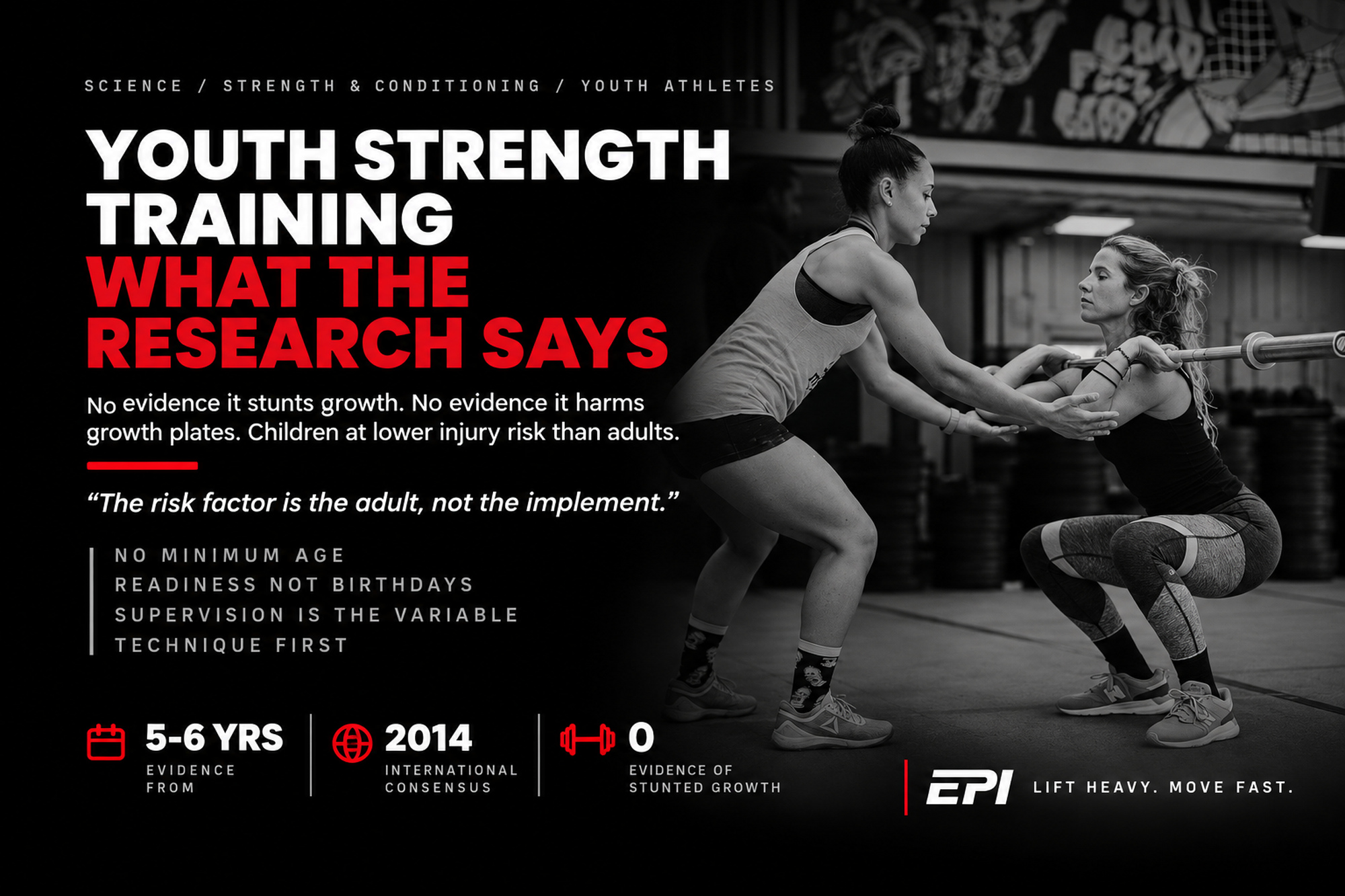
On growth and height. There is no scientific evidence that resistance training adversely affects linear growth, and none that it reduces adult height. This is the most persistent myth in the field, and nothing supports it.
On injury risk. Children have a lower risk of resistance training injury than adults, mainly sprains and strains. Not comparable: lower. In a prospective one-year study of school-aged youth, resistance training accounted for 0.7% of 1,576 injuries, far fewer than football, basketball and soccer. Where injuries do occur in youth, most are accidental: weights dropped on hands and feet, often at home, without supervision. Lower back pain is the one to watch, and it is mostly linked to poor technique and heavy lifting in adolescent powerlifters.
On injury prevention. Well-designed programmes can reduce sports-related injuries. The consensus says resistance training should be a core part of preparation for aspiring young athletes, not an optional extra. The evidence is strongest for overuse injuries and for knee injury risk in adolescent girls, and around 50% of youth overuse injuries are thought to be preventable with appropriate training and management.
On benefits. The NSCA lists seven areas where well-designed youth resistance training helps: muscular strength and power; cardiovascular risk profile; motor skill and sports performance; resistance to sports injuries; psychosocial well-being; and long-term exercise habits, on top of being relatively safe. In practice that means gains in strength, power, sprinting, jumping and general motor skill; better body composition, bone health and insulin sensitivity in overweight adolescents; and psychological benefits, which appear mainly when the programme focuses on self-improvement and enjoyment rather than competition.
There is no minimum age, and that surprises people
Neither the consensus nor the NSCA sets a minimum age. Children as young as five or six can make noticeable gains in muscular fitness with basic exercises. The NSCA’s working rule is simple: if a child is ready for sport, generally around age 7 or 8, they are ready for some form of resistance training. A medical examination isn’t required for healthy children, but is recommended for any child with signs or symptoms of disease.
What matters instead is readiness. The child should be emotionally mature enough to accept and follow directions, and should have competent balance and postural control.
Why age is the wrong question anyway
The consensus calls chronological age a weak indicator of maturational status. Two 13-year-olds in the same squad can be years apart biologically. Programmes should account for both biological maturation and training age, meaning how long someone has actually trained. A 14-year-old with four years of coaching and a 14-year-old who has never lifted should not get the same session.
Tracking maturation
Two simple, non-invasive methods give coaches a usable estimate. The first predicts the percentage of adult height a child has reached (the Khamis-Roche method, which uses the parents’ heights). The second estimates the years before or after peak height velocity (PHV), the fastest phase of the growth spurt.
Measure standing height every three months to catch the growth spurt as it starts. Around PHV, limbs lengthen faster than the athlete can control them, coordination can regress and injury risk rises, so this is the time to manage jumping volume and re-groove technique, not to chase new maxes.
Training age
The NSCA defines training age in three levels: novice (up to 2–3 months of resistance training), intermediate (3–12 months) and advanced (12 months or more). Most youth programming gets this wrong in both directions: it under-challenges the experienced child and overloads the novice of the same age.
Too much sport, too young
For many young athletes, the bigger risk isn’t the weights room. It is doing too much of one sport too early. Early specialisation means intensive, year-round training (more than 8 months a year) in a single sport, starting before puberty. It is common in gymnastics, figure skating, dance, tennis and swimming, and about 30% of youth in one study of 1,190 US athletes were highly specialised. Fewer than 1% of high-school athletes go on to play professionally.
Two volume rules
- Hours per week should not exceed the child’s age in years, and never more than 16 hours a week of organised sport.
- Above 16 hours a week of specialised activity, monitor the athlete for overtraining and burnout.
Parents are rarely told this. In one survey, about 84% didn’t know the hours-per-week recommendation, 82% didn’t know the months-per-year recommendation and only 43% believed year-round play increases the risk of overuse injury. In Gaelic games, over a quarter of injuries in adolescent footballers (26.7%) and hurlers (26.5%) are overuse injuries.
Where S&C fits
Moeskops et al. (2022) argue that strength and conditioning should replace part of the sport volume, not be added on top. Their practical strategies:
- Two neuromuscular sessions a week is enough to improve motor skills.
- Put S&C before sport practice where you can. In prepubertal tennis players, a programme run before tennis sessions improved sprint, jump and serve velocity more than the same programme run after.
- Watch for spikes. In one study, increases in workload of more than two standard deviations were linked to a 4–5 times higher injury risk over the next four weeks. Session RPE, using child-friendly scales and collected within 30 minutes, is a simple way to track it.
- Build in recovery. Plan 2–4 week transition or deload phases after competition, and use fun “challenge weeks” of varied movement tasks to keep children engaged.
Where the actual risk is
Most resistance training injuries in young people happen when they are unsupervised, or supervised by people giving unqualified instruction. The risk factor is the adult, not the implement.
What about the Olympic lifts?
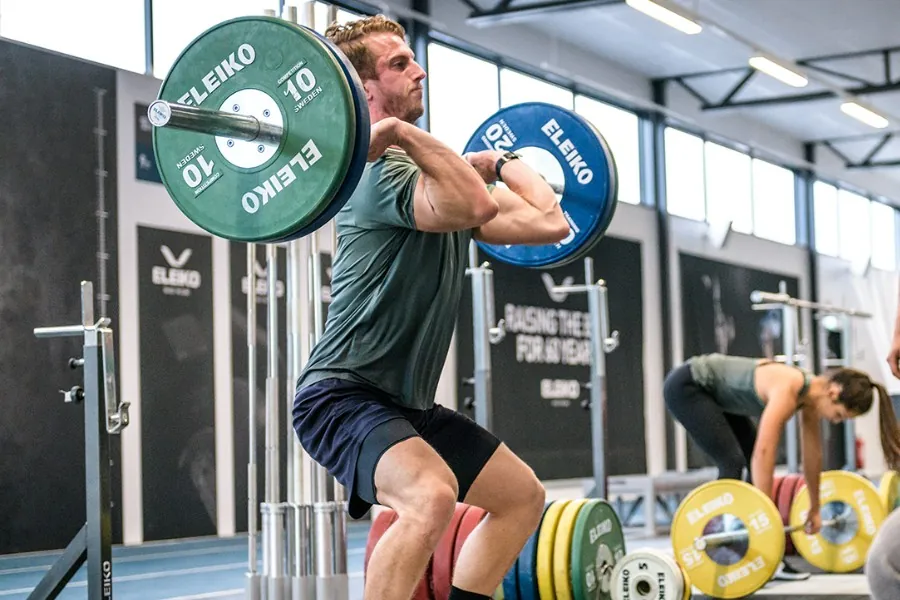
The consensus singles out weightlifting movements as needing instructors with specific qualifications and experience of coaching children. Teaching a 12-year-old to clean is a coaching problem before it is a loading problem. Taught well, though, weightlifting is one of the safest ways young people train. British Weightlifting’s position statement compiles the injury data:
- Pierce et al. (1999) followed 70 youth weightlifters for a year with no injuries that cost training time. Byrd et al. (2003) followed 11 lifters aged 9–15 for 22 months with no injuries.
- Myer et al. (2009) found most youth injuries were to the hands and feet from dropping or replacing weights: accidents that better supervision would likely prevent.
- In Chaouachi et al. (2014), 63 boys aged 10–12 who did weightlifting made similar or greater gains than those doing traditional resistance or plyometric training.
- British Weightlifting’s under-13 competitions are judged on technique, not load.
British Weightlifting defines a qualified professional in three parts: a recognised qualification in the field; the paediatric exercise science knowledge to programme for a child’s developmental needs, including when to progress or modify; and an understanding of how to communicate with young people.
Risks you can control
| Risk factor | How to manage it |
|---|---|
| Unsafe environment or equipment storage | Enough space, a sensible layout and secure storage |
| Unsafe use of equipment | Clear safety rules, taught and enforced |
| Excessive load or volume | Progress only when technique allows |
| Poor technique | Qualified instruction and regular feedback |
| Poor trunk control | Neuromuscular and core training |
| Muscle imbalances | Balanced agonist and antagonist exercises |
| Previous injury | Liaise with the athlete’s clinician |
| Sex-specific growth changes | Targeted training, e.g. landing mechanics in adolescent girls |
| Poor recovery | Active rest, nutrition and sleep |
The practical implication: money is better spent on coach competence and coach-to-athlete ratios than on equipment.
What good youth strength and conditioning looks like
It is designed by someone who understands paediatric exercise science as well as coaching. The consensus treats these as two separate skills.
It is supervised at a ratio that lets the coach see technique.
It is progressed on competence, not the calendar. A child moves on when they can control the movement, not when a training block ends. The NSCA suggests increasing load by 5–10% only once technique is solid.
It treats technique as the outcome in the early years. Load is a tool for teaching movement, not the point of the session.
It is enjoyable. The psychological benefits are tied to self-improvement and enjoyment, and a child who stops turning up gets no benefit at all.
It is part of a broader physical education. Resistance training sits alongside sprinting, jumping, landing, changing direction and play. A programme that only lifts is not youth athletic development.
The NSCA’s programming guidelines
- A 5–10 minute dynamic warm-up, then light loads while technique is learned.
- Strength: 1–3 sets of 6–15 reps. Power: 1–3 sets of 3–6 reps.
- Include trunk and balance work, and train 2–3 times a week on non-consecutive days.
- Keep training logs, vary the programme, and look after nutrition, hydration and sleep.
Progression by training age
| Level | Strength: load | Sets × reps | Rest | Power: load and sets × reps |
|---|---|---|---|---|
| Novice | 50–70% 1RM | 1–2 × 10–15 | 1 min | 30–60% 1RM, 1–2 × 3–6 |
| Intermediate | 60–80% 1RM | 2–3 × 8–12 | 1–2 min | 30–60% (speed) and 60–70% (strength), 2–3 × 3–6 |
| Advanced | 70–85% 1RM | ≥3 × 6–10 | 2–3 min | 30–60% (speed) and 70–≥80% (strength), ≥3 × 1–6 |
Frequency is 2–3 sessions a week for novice and intermediate athletes, and 3–4 for advanced. Adapted from Faigenbaum et al. (2009).
The bigger picture: long-term athletic development
The NSCA’s position statement on long-term athletic development (LTAD) frames youth strength training as one part of a much longer process. Its starting point is that children are not miniature adults. Its ten pillars:
- Individual, non-linear pathways. Development follows the child’s growth and maturation, not a fixed timeline.
- For all youth. Every age, ability and aspiration, covering both physical fitness and psychosocial well-being.
- Fitness from early childhood. Motor skill and muscular strength are the primary focus.
- Sport sampling. Encourage a range of sports early on and avoid early specialisation.
- Health and well-being first. This is the central principle of the whole framework.
- Reduce injury risk. Use conditioning to make young athletes more robust.
- A range of training modes. Develop both health-related and skill-related fitness.
- Monitor and assess. Use appropriate tools to track progress and growth.
- Progress systematically. Individualise training and progress it over time.
- Qualified professionals. Delivered by people with sound pedagogy and youth expertise.
Behind all ten sits physical literacy: the motivation, confidence, physical competence, knowledge and understanding to value and take part in physical activity for life.
Applying it in Irish sport: youth GAA
Duggan et al. (2022) applied this evidence to Gaelic games, and their findings travel well to any Irish club or school setting.
- Movement skills are the starting point. Only 11% of Irish 12–13-year-olds were proficient in fundamental movement skills. Childhood is the best time to build them.
- Contact time is limited. With most youth teams training on the pitch two or three times a week for 60–90 minutes, athletic development has to be built into the warm-up and the session, not bolted on.
- Coach in an autonomy-supportive way. Give young players choice and explain the why. It supports motivation and long-term participation.
- Agility before puberty should emphasise fundamental movement skills (around 60%), then change of direction speed (25%) and reactive agility (15%).
A plyometric progression
| Phase | Focus | Examples |
|---|---|---|
| 1 | Landing mechanics and eccentric control, longer ground contacts (over 250 ms) | Drop and stick, snap-downs, low box landings |
| 2 | Low-intensity, fast plyometrics with short ground contacts | Pogo jumps, skipping, line hops |
| 3 | Higher-intensity reactive jumps, contacts under 250 ms | Hurdle hops, depth jumps |
Pre-PHV boys respond well to plyometric training, while post-PHV athletes gain more from combined strength and plyometric training. For reference, U18 inter-county Gaelic footballers averaged a countermovement jump of 43.3 cm and a standing long jump of 198 cm.
If you are a parent
Two questions tell you most of what you need to know about a programme:
Who is coaching, and what are they qualified in? A qualification in coaching young athletes is not the same as a general fitness qualification applied to children.
How many children per coach? If nobody can see your child’s technique, nobody is managing their risk.
And a third, about the bigger picture: how many hours of sport is your child doing? If it is more hours a week than their age, or more than 16, that is the risk worth worrying about, not the weights.
If you are a PE teacher or sport coach
You are probably already doing resistance training without calling it that: bodyweight circuits, medicine ball throws, jumping and landing. The consensus treats this as a continuum. Adding external load is a progression within it, not a separate and riskier activity.
Two short neuromuscular sessions a week, ideally before sport practice, is a realistic target for most schools and clubs. The step most worth taking is formalising your own competence in coaching young athletes, because the evidence says that is what governs the risk.
EPI delivers the National Certificate in Strength and Conditioning in Dublin and Belfast, and a dedicated Youth Strength and Conditioning Course.
Frequently asked questions
At what age can a child start strength training?
There is no fixed minimum age. Children as young as five or six can gain from basic exercises, and the NSCA says a child ready for sport, generally around 7 or 8, is ready for some form of resistance training. Readiness means following directions and having competent balance and postural control.
Does lifting weights stunt growth?
No. There is no scientific evidence that resistance training adversely affects linear growth, and none that it reduces adult height.
Can weight training damage a child’s growth plates?
The evidence doesn’t support it. No growth cartilage injury has been reported in any prospective youth resistance training study, and appropriate loading may benefit bone formation. Most youth injuries happen when children are unsupervised or poorly instructed.
Is strength training safer for adults than for children?
The reverse. Children have a lower risk of resistance training injury than adults, particularly for sprains and strains.
Is Olympic weightlifting safe for children?
Yes, when taught by a qualified coach with an emphasis on technique. Reported injury rates in youth weightlifting are a tiny fraction of those in team sports like rugby.
How many hours of sport should a child do each week?
No more hours a week than their age in years, and no more than 16 hours a week. Above that, monitor for overtraining and burnout.
Should a programme be based on a child’s age?
Not on chronological age alone. Programmes should account for biological maturation and training age.
The evidence is clear that the coach governs the risk. EPI’s Youth Strength and Conditioning Course (YSCC) gives coaches, PE teachers and parents the knowledge to train young athletes safely and effectively.
Check the Dublin dates, or ask EPI whether your existing qualification counts towards Phase 2 entry.
References
- British Weightlifting. (2016). Youth weightlifting: position statement. Kite, R., Lloyd, R. S., & Hamill, B. British Weight Lifting.
- Duggan, J. D., Moody, J., Byrne, P., McGahan, J. H., & Kirszenstein, L. (2022). Considerations and guidelines on athletic development for youth Gaelic Athletic Association players. Strength and Conditioning Journal, 44(2).
- Faigenbaum, A. D., Kraemer, W. J., Blimkie, C. J. R., Jeffreys, I., Micheli, L. J., Nitka, M., & Rowland, T. W. (2009). Youth resistance training: Updated position statement paper from the National Strength and Conditioning Association. Journal of Strength and Conditioning Research, 23(Suppl. 5), S60–S79.
- Hamill, B. P. (1994). Relative safety of weightlifting and weight training. Journal of Strength and Conditioning Research, 8, 53–57.
- Howard, R., Eisenmann, J. C., & Moreno, A. (2019). Summary: The National Strength and Conditioning Association position statement on long-term athletic development. Strength and Conditioning Journal, 41(2), 124–126.
- Lloyd, R. S., Faigenbaum, A. D., Stone, M. H., Oliver, J. L., Jeffreys, I., Moody, J. A., et al. (2014). Position statement on youth resistance training: The 2014 International Consensus. British Journal of Sports Medicine, 48(7), 498–505.
- Lloyd, R. S., Cronin, J. B., Faigenbaum, A. D., et al. (2016). National Strength and Conditioning Association position statement on long-term athletic development. Journal of Strength and Conditioning Research, 30(6), 1491–1509.
- Moeskops, S., Oliver, J. L., Read, P. J., Cronin, J. B., Myer, G. D., & Lloyd, R. S. (2022). Practical strategies for integrating strength and conditioning into early specialization sports. Strength and Conditioning Journal, 44(1), 34.
- Pierce, K., Byrd, R., & Stone, M. (1999). Youth weightlifting: Is it safe? Weightlifting USA, 17, 5.