Online study is better for theory, flexibility and cost. In-person is better for coaching skill, because the one thing a screen cannot do is watch you coach and correct you. Most coaches are best served by doing both — the knowledge online at their own pace, the practical assessment in a room with an instructor.
The honest version of this question is not “which is better.” It is “which parts of this subject can be learned at a distance, and which cannot.”
The answer is unusually clear once you separate them, and it does not favour either format across the board. We deliver both, which is either a reason to distrust what follows or a reason to think we have had to work it out properly. I will try to make it the second.
Separate the knowledge from the craft
Strength and conditioning has two components that behave completely differently as learning problems.
The knowledge. Programme design, periodisation, energy systems, the research underpinning velocity-based methods, testing protocols, load management. This is information. It can be delivered by video, text, lecture or conversation, and the evidence on distance learning for this kind of material is good.
The craft. Spotting that an athlete’s knee is collapsing under fatigue and knowing which three words will fix it before the next rep. Teaching a clean to someone who has never held a barbell. Managing a room of twenty when four of them do not want to be there.
The first transfers online intact. The second does not, and no amount of production budget changes that.
What online genuinely does better
Pace. You can take a section three times. In a room, the instructor moves on.
Cost. No travel, no accommodation, no days off work. For someone outside a major city or outside the country, that is often the difference between studying and not.
Timing. Shift workers, parents, coaches in-season. A six-day in-person course assumes six days you can actually give.
Reference. Good on-demand content stays available. Eighteen months later, when you are actually programming for a sport you have not worked with before, you can go back to the module. Nobody remembers everything from a weekend.
Reach. We have certified coaches across more than twelve countries. Most of them were never going to fly to Dublin, and the alternative to online for them was nothing.
What online cannot do, stated plainly
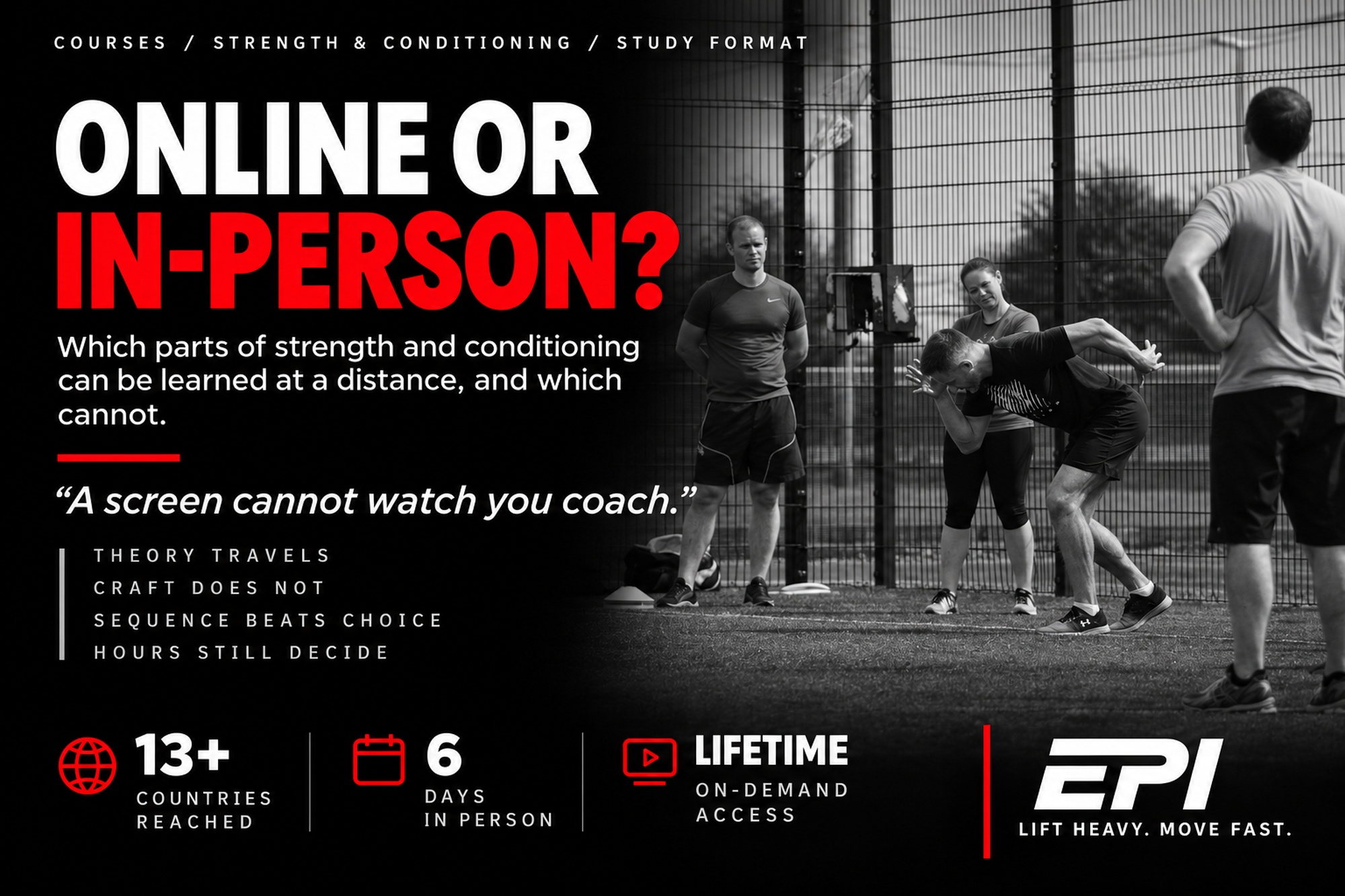
It cannot watch you coach. This is the whole thing. Coaching competence is assessed by someone experienced observing you work with real people and telling you what you did not notice. Video submission is a partial substitute at best — you choose the clip, you choose the athlete, and you are not being corrected in the moment.
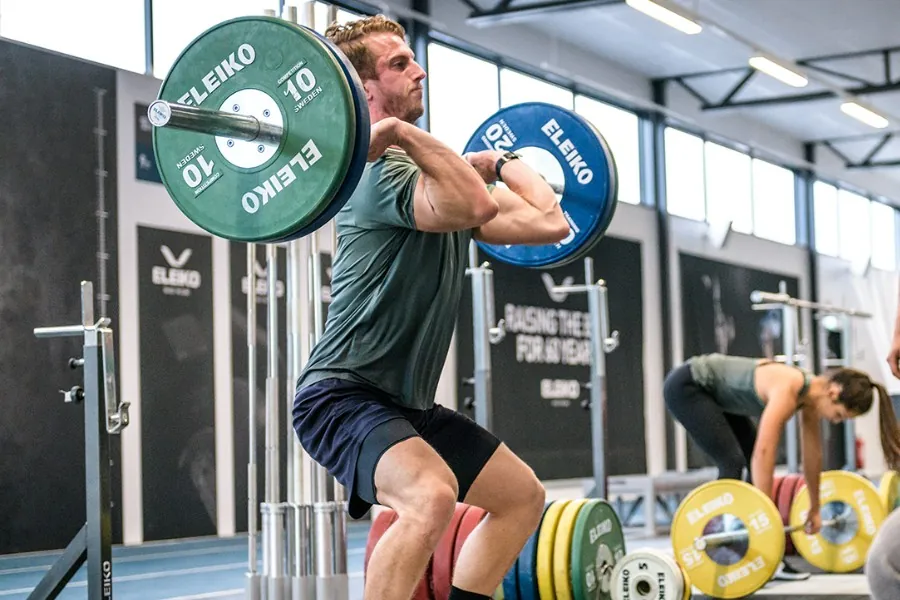
It cannot put a bar in your hands. You can watch a hundred hours of weightlifting technique content and still not know what a well-timed second pull feels like. Some things are kinaesthetic.
It cannot replicate the room. Managing a group, reading the energy, adjusting when the squat racks are taken — these are situational skills and they need situations.
It struggles with the questions you do not know to ask. In a room, somebody else asks the thing you had not thought of, and the instructor goes off-script for ten minutes. That is frequently where the most useful material comes from, and it does not survive the transfer to a recorded module.
Completion. Self-paced study has a dropout problem and pretending otherwise helps nobody. If you know you need a fixed date in a diary to finish anything, that is real information about yourself and you should plan around it.
The honest recommendation
For most people, it is not a choice. It is a sequence.
Take the knowledge online, at your own pace, where you can revisit it. Then put yourself in a room with an instructor for the practical component, where somebody watches you coach and tells you what is wrong. Then go and accumulate supervised hours, which neither format substitutes for.
That is why our in-person National Certificate includes on-demand access rather than treating the two as alternatives. The theory sits online where it belongs and can be returned to; the coaching is assessed in person because it cannot be assessed any other way.
Choosing, by situation
You are outside Ireland and the UK. Online, without hesitation. Then find practical assessment and supervised hours locally, wherever you are. The alternative is not an in-person course — it is no course.
You are early in your career and can travel. In person, for the practical component especially. Your coaching eye is the asset you are building and it is built by being corrected.
You are an experienced coach adding a specialism. Online. You already have the craft; you are after the content. Velocity-based training is a good example — the method is specific, the research is specific, and you do not need somebody to teach you how to stand near a barbell.
You are in-season and cannot take six days. Online now, in-person in the off-season. Do not wait for a window that is not coming.
You know you do not finish self-paced courses. In person. Pay for the accountability. It is a legitimate reason and a common one.
What to ask any online provider
How is the practical component assessed, if at all? If the answer is “there isn’t one,” that is not disqualifying, but you should know you are buying knowledge rather than certification of coaching competence.
Who recognises it, and for what? “Accredited” with no named body means nothing. Ask which organisation and what the recognition entitles you to.
How long do I have access? Lifetime access and twelve-month access are very different products at a similar price.
Is there a person to ask? The difference between a good online course and a video library is whether somebody answers when you are stuck.
What happens after? The certificate is not the outcome. The outcome is coaching competently, and that requires hours nobody can sell you.
EPI delivers the National Certificate in Strength and Conditioning in Dublin and Belfast, beginning with the Phase 1 strength and conditioning course.
Frequently asked questions
Is an online strength and conditioning certification respected by employers?
It depends on the body behind it more than the delivery format. Employers generally name accreditations such as the UKSCA ASCC or NSCA CSCS rather than specifying how a course was delivered. What they consistently ask for is documented coaching hours.
Can you learn to coach strength and conditioning online?
You can learn the knowledge. Coaching competence requires someone experienced observing you work with real athletes and correcting you, which is why most credible pathways include an in-person practical component.
Is online cheaper than in-person?
Usually, and the saving is larger than the course fee alone — no travel, accommodation or time off work. For international learners that difference is often decisive.
Should I do online first or in-person first?
Online first works well for most people. You arrive at the practical component already knowing the theory, which means the in-person days can be spent coaching rather than listening.
Do online courses include practical assessment?
Some do via video submission, many do not. Ask directly before enrolling, because it changes what the certificate actually evidences.
Written by Karl Gilligan, MSc, CSCS, founder of Elite Performance Institute (EPI). Karl has coached at Rugby World Cup and Olympic Games level and has worked in strength and conditioning for over twenty years.