There are three routes into strength and conditioning: a sport science degree, a certification pathway, or in-service experience built through internships. Most working coaches combine two of them. A degree is required for the NSCA CSCS but not for the UKSCA ASCC. In every route, documented supervised coaching hours decide who gets hired.
Strength and conditioning is one of the few professions where there is no single door. No licence, no mandatory register, no legally protected title. That sounds like freedom and mostly feels like fog, because it leaves every person trying to enter the field assembling their own route from incomplete information.
Here is what the routes actually are, what each one costs you in time, and what separates the people who build a career from the people who collect certificates.
First, what the job actually involves
Strength and conditioning is the physical preparation of athletes for sport. That means programming for performance outcomes rather than appearance, managing training load across a competitive season, testing and monitoring, working alongside coaches and medical staff, and returning athletes to play after injury.
It overlaps with personal training in the exercise science underneath it, and diverges almost everywhere else. The client is not the athlete alone — it is the athlete, the sport coach, the season, and often the physio. Most of the job is coordination and judgement. The programming is the easy part.
Route one: the degree
A degree in sport science, exercise science, kinesiology or a related field.
What it gives you. The underlying science in depth, usually some lab and testing experience, and in good programmes a placement. It is the baseline expectation for university sport departments and for research-adjacent roles, and it is a hard requirement for the CSCS.
What it does not give you. Coaching ability. A degree teaches you why a programme works; it does not teach you to hold a room of eighteen-year-olds through a session they are not enjoying. Graduates who have never coached under supervision are routinely outperformed in practical trials by people with less education and more hours.
Time. Three to four years, plus a master’s in some cases.
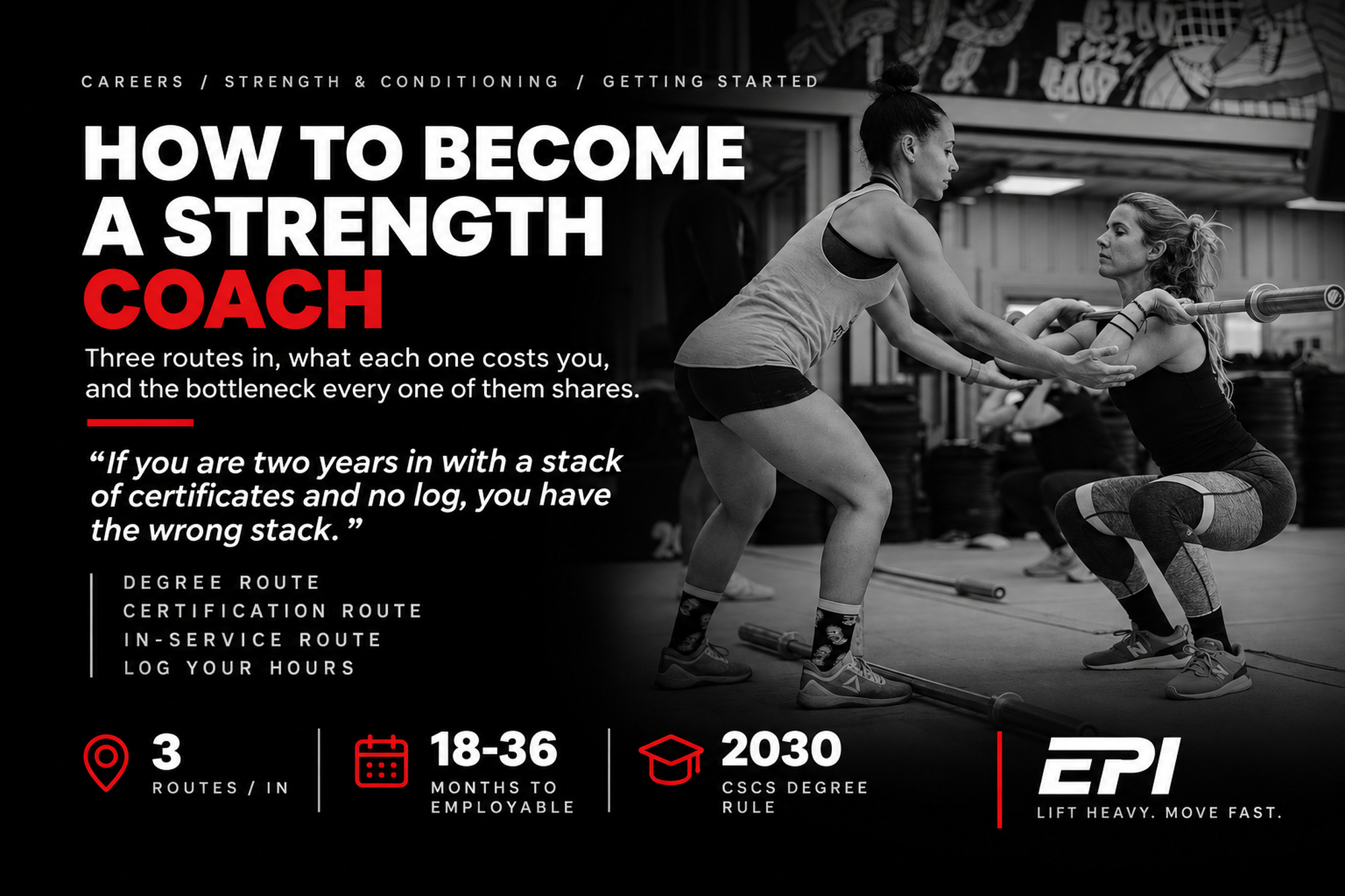
Route two: the certification pathway
Courses and accreditations rather than a degree.
What it gives you. Focused, applied content in months rather than years, usually with practical assessment. Good courses put you in front of people and mark you on coaching, not just on knowledge.
Worth being precise about the two things people conflate here. A course teaches you the subject and gives you a certificate. An accreditation — the UKSCA ASCC, the NSCA CSCS — assesses you against a professional standard. They are different objects. Most employers in professional sport name the accreditation; most of the actual learning happens in the course.
The catch. Course quality varies enormously and the sector is lightly regulated, so “accredited” with no named body behind it is a phrase you should treat as a warning rather than a reassurance. Ask who recognises the course, and for what.
Time. Six months to two years depending on how you stack it.
Route three: in-service
Internships, academy placements, volunteering with a club, assisting an established coach.
What it gives you. The thing the other two routes cannot: hours, context and references from people who have watched you work. Nearly every coach I know in professional sport came through some version of this, usually unpaid for longer than they expected.
The catch. It is the least accessible route. Unpaid internships filter by who can afford to do them, which is a genuine problem in this industry and not one I am going to pretend otherwise about. If you need to earn while you learn, stack it part-time alongside paid work rather than treating it as all-or-nothing.
Time. Ongoing. It never really stops.
Can you become an S&C coach without a degree?
Yes, with two caveats worth knowing before you plan around it.
You cannot sit the NSCA CSCS without one. It currently requires a bachelor’s degree or higher, or enrolment as a college senior at an accredited institution. From 2030 it will require a bachelor’s degree from a CASCE-accredited programme, with the current rule in place until 31 December 2029.
The UKSCA ASCC has no degree requirement. It is competency-based — an assessment day and a written element with a 65% pass mark — and a degree does not exempt you from any part of it. For a non-graduate in the UK or Ireland, that is the realistic accreditation route.
Outside those two, plenty of coaches work successfully in private facilities, youth development and club sport without a degree. What they have instead, without exception, is hours and a reputation.
The part most people underestimate
Every route converges on the same bottleneck: documented supervised coaching hours.
Not “I’ve trained people.” A record showing who you coached, in what sport, at what level, over what period, and who supervised you. Breadth matters — different sports, different ages, different training ages — because the question an employer is really asking is whether you can adapt.
If you are two years in and have a stack of certificates and no log, you have the wrong stack.
A realistic timeline
For someone starting from a related background — a personal trainer, a sport coach, a physio — a workable version looks roughly like this.
Months 1 to 6. Learn the subject properly through a course with assessed practical coaching. Start volunteering with one club in one sport while you do it.
Months 6 to 18. Build hours. Widen to a second sport or a different age group. Keep the log from day one, because reconstructing it later is miserable.
Months 18 to 30. Sit an accreditation. By this point you have coached enough that the assessment tests something real rather than something rehearsed.
Throughout. Get seen. The first job almost always comes from someone who watched you coach, not from an application form.
Coming in with no background, add the degree at the front and the rest still applies.
Where first jobs actually come from
Academy and development squads at clubs. University sport programmes. Private performance facilities. Schools with athletic development programmes. Sport-specific national governing body pathways.
Almost none of them advertise the entry-level roles widely, and most are filled by someone who was already around the building. That is not a reason to despair — it is a reason to be around a building.
What this costs you
Honestly: time more than money. The courses and accreditations are not trivially cheap but they are not the barrier. The barrier is eighteen months to three years of building hours while earning somewhere else, and most people who drop out drop out there rather than at an exam.
Knowing that in advance is worth more than any syllabus.
EPI delivers the National Certificate in Strength and Conditioning in Dublin and Belfast, beginning with the Phase 1 strength and conditioning course.
Frequently asked questions
Do I need a degree to be a strength and conditioning coach?
Not in general, but the NSCA CSCS requires one — a bachelor’s degree currently, and from 2030 one from a CASCE-accredited programme, with the existing rule holding until 31 December 2029. The UKSCA ASCC has no degree requirement.
How long does it take to become a strength and conditioning coach?
From a related background, typically eighteen months to three years to reach employability — a course, accumulated supervised hours, then an accreditation. From no background, add a three to four year degree.
What is the difference between a personal trainer and a strength and conditioning coach?
A personal trainer works with general population clients toward health and appearance goals. An S&C coach prepares athletes for sport performance, managing training load across a competitive season alongside sport coaches and medical staff.
Which qualification should I do first?
Learn the subject before you sit an accreditation. A course with assessed practical coaching gives you the knowledge and your first supervised hours; the accreditation then tests a competence you actually have rather than one you have revised for.
Can I become an S&C coach while working another job?
Most people do. Part-time volunteering with one club alongside paid work is the standard route, and it is slower but considerably more survivable than an unpaid full-time internship.
Written by Karl Gilligan, MSc, CSCS, founder of Elite Performance Institute (EPI). Karl has coached at Rugby World Cup and Olympic Games level and has worked in strength and conditioning for over twenty years.