Most UK and Irish S&C job adverts name the UKSCA ASCC. International and academic roles more often name the NSCA CSCS. Course certificates such as the NCSC demonstrate knowledge and practical competence but are not accreditations — they sit earlier in the pathway. A strong application usually pairs a course with an accreditation and documented coaching hours.
There is a difference between the qualification that teaches you the job and the credential that gets you shortlisted for it. Most people researching strength and conditioning courses are not told this, and it leads to a predictable frustration: a coach finishes a course, applies for a role, and finds the advert asking for something else entirely.
This is a plain breakdown of what employers actually write down, what each credential is, and how they fit together.
What job adverts actually say
Read enough S&C vacancies and the language settles into a pattern.
Roles in the UK and Northern Ireland — professional clubs, academies, university sport departments, national governing bodies — most commonly name the UKSCA ASCC, either as essential or as desirable. In many academy and assistant roles it appears as “ASCC or working towards.”
Roles outside those markets, and academic or research-adjacent posts anywhere, more often name the NSCA CSCS.
Private facilities, performance gyms and youth development programmes tend to be looser. They ask for a relevant qualification, a degree or equivalent, and practical experience — and in those settings the interview and the practical trial carry more weight than the certificate.
Almost all of them, in every sector, ask for coaching hours. That is the line most applicants underestimate.
The three things people are comparing, and why they are not comparable
NSCA CSCS — an individual certification
The Certified Strength and Conditioning Specialist is an exam-based certification awarded to an individual, not a course you attend. To sit it you currently need a bachelor’s degree or higher, or to be enrolled as a college senior at an accredited institution, plus a current CPR/AED certification.
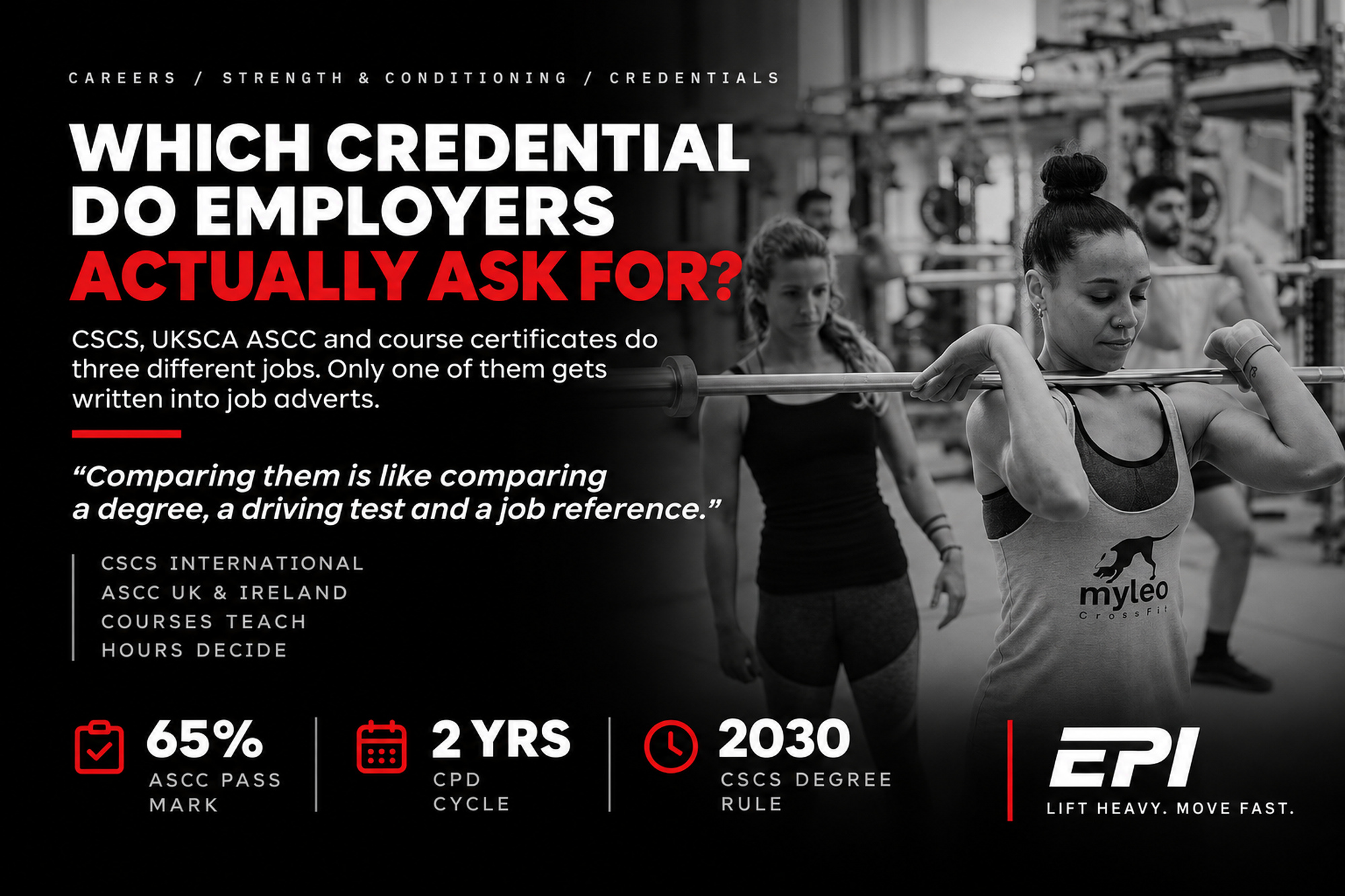
One date to put in your planning: from 2030 the NSCA will require a bachelor’s degree from a CASCE-accredited programme. The current degree requirement stays until 31 December 2029. If you are mid-degree now, or choosing one, that is worth checking before you commit.
The CSCS is the credential with the widest international recognition. If your career might take you beyond Britain and Ireland, it is the one that travels.
UKSCA ASCC — an accreditation against a standard of practice
The Accredited Strength and Conditioning Coach is competency-based. It involves an assessment day and a written element with a 65% pass mark, and accredited coaches submit CPD evidence every two years to retain it.
A degree does not exempt you from the assessment. The UKSCA is explicit that the ASCC is a standard of practice rather than a qualification, which is exactly the right way to understand it: it tests whether you can coach to a standard, not whether you have studied.
For UK and Northern Irish employment, this is the credential named most often.
Course certificates such as the NCSC — the education
A course certificate says you have been taught the subject and, in a good course, assessed on your practical coaching. It is not an accreditation and should never be presented as one.
Our own National Certificate in Strength and Conditioning is approved for continuing education units by the NSCA and ACE. It is not an NFQ or RQF levelled award, and it does not award the CSCS or the ASCC. What it does is teach the content and put you under supervision with a bar to clear.
These three things sit at different points on one pathway. Comparing them against each other is like comparing a degree, a driving test and a job reference.
Sector by sector, what actually opens the door
Professional clubs and academies. The ASCC or working towards it, plus hours in a comparable environment. Internships and part-time academy work are how most people get the hours, and that is a longer road than the course marketing usually admits.
University and college sport. Often a degree as a baseline, the ASCC or CSCS named, and in research-facing departments a master’s. This is the most credential-driven sector of the lot.
Private performance facilities. The practical trial decides it. Credentials get you the trial; coaching the session gets you the job. I have hired people here on the strength of one session who had fewer letters after their name than the applicant they beat.
Youth and schools. Safeguarding clearance first, then a demonstrable understanding of age-appropriate programming. A youth-specific qualification is worth more here than a general one, because the employer’s main concern is risk.
Tactical and military. Varies widely by contract. Often specifies a recognised certification without naming one, which in practice means the CSCS or the ASCC.
The three things that matter more than most people expect
Documented coaching hours. Not “I train people.” A log: who, what sport, what level, over what period, supervised by whom. Across twenty years I have found hours under supervision to be a better predictor of competence than any single credential, and employers who have hired badly once tend to agree.
A sport you actually understand. Being credible in one sport beats being generic across ten. Interviewers ask sport-specific questions because that is where generic knowledge falls apart.
References from people who have watched you coach. Not people who taught you. People who have seen you run a session with athletes who did not want to be there.
The pathway that works, honestly stated
If you are starting out, the order that makes sense is usually: learn the subject properly, get supervised hours, then accredit.
A good course gives you the knowledge base and your first assessed practical coaching. Hours give you the competence and the evidence. The ASCC or CSCS then confirms, to an employer who has never met you, that you coach to a recognised standard.
Doing it in reverse — chasing the accreditation before you have coached anyone — is possible for the CSCS if you have the degree, and it produces coaches who pass exams and struggle on the gym floor.
And to answer the question that sits underneath all of this: an education provider and an accrediting body are not alternatives. The provider teaches; the body assesses against a standard. Most coaches who take this seriously end up with both, and the sequence matters less than the fact that neither one substitutes for the other.
EPI delivers the National Certificate in Strength and Conditioning in Dublin and Belfast, beginning with the Phase 1 strength and conditioning course.
Frequently asked questions
Which is better, the CSCS or the ASCC?
Neither is better in the abstract. The ASCC is named more often in UK and Northern Irish job adverts. The CSCS carries further internationally and in academic settings. Coaches working across both markets frequently hold both.
Can I work in strength and conditioning without a degree?
Yes in many private and club settings, but not via the CSCS, which requires a bachelor’s degree — and from 2030 will require one from a CASCE-accredited programme, with the current rule in place until 31 December 2029. The UKSCA ASCC has no degree requirement, though it assesses everyone the same way regardless of qualifications.
Is a course certificate enough to get hired?
In private facilities and some youth settings, often yes, when combined with coaching hours and a strong practical trial. In professional sport and university roles, usually not on its own — those adverts tend to name an accreditation.
How many coaching hours do employers expect?
It varies by role, but the quality of the log matters more than the raw number. Supervised hours across different sports, levels and athlete populations carry more weight than a large total accumulated in one setting.
Does a strength and conditioning course expire?
Course certificates generally do not. Accreditations do have ongoing requirements — the UKSCA ASCC requires CPD evidence every two years, and the CSCS has its own recertification cycle.
Written by Karl Gilligan, MSc, CSCS, founder of Elite Performance Institute (EPI). Karl has coached at Rugby World Cup and Olympic Games level and has worked in strength and conditioning for over twenty years.