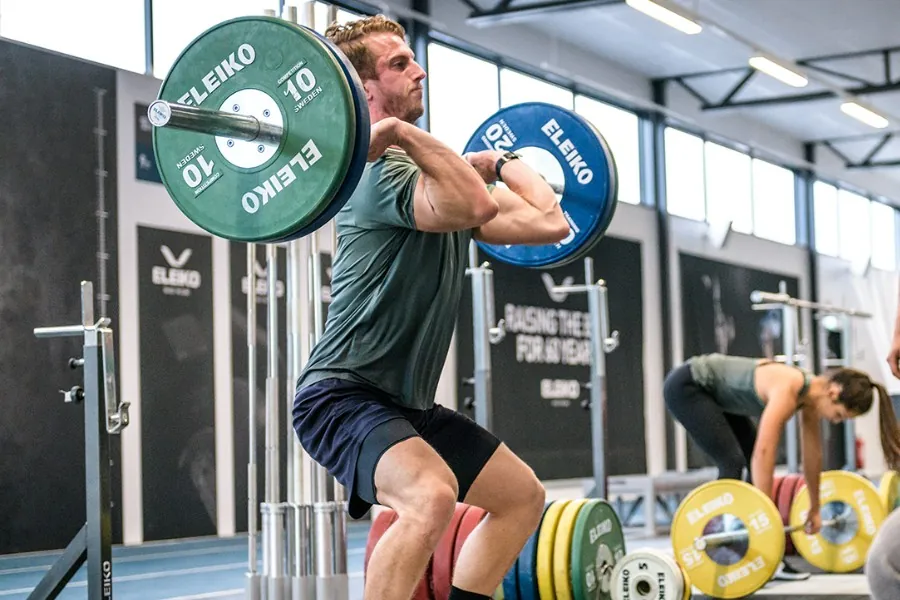

Hypertrophy for General Population Clients
An evidence-based guide for coaches: how many sets, how heavy, how close to failure, how often, and how much protein your everyday clients need to build muscle.
Most general population clients will never step on a bodybuilding stage, yet nearly all of them benefit from building muscle. For coaches and personal trainers, the evidence now points to a simple, repeatable recipe: around 10 to 20 hard sets per muscle per week, mostly in the 6 to 12 rep range at 60 to 85% of one-repetition maximum (1RM), stopped 1 to 3 reps short of failure, with each muscle trained at least twice a week and enough protein to support growth.
This article expands on our carousel, Hypertrophy for General Population. It draws on two sources: Brad Schoenfeld’s textbook Science and Development of Muscle Hypertrophy (2nd ed., 2021) and a 2019 systematic review of advanced resistance training techniques by Krzysztofik and colleagues. Where the two differ, we say so and explain the choice we make for everyday clients.


Muscle is medicine
The case for hypertrophy training goes well beyond appearance. Krzysztofik et al. (2019) note that low levels of muscle mass are associated with increased risk of cardiovascular disease, cardio-metabolic risk in adolescents, and type II diabetes in middle-aged and older adults. Schoenfeld (2021) adds that muscle mass peaks between the third and fifth decades of life and then declines progressively, a process known as sarcopenia. Regular resistance training can slow that loss and even push older adults above the muscle mass of sedentary younger people.
The good news for coaches is that virtually everyone can increase muscle mass above baseline with consistent training (Schoenfeld, 2021). Genetics, age and sex shape how much a client will gain, but not whether they can. Your job is to dose the same principles to each client’s level.
How muscle actually grows
Hypertrophy happens when muscle protein synthesis outpaces muscle protein breakdown over time, leaving a positive net protein balance (Krzysztofik et al., 2019). Resistance training and protein intake are the two levers that tip that balance.
Three mechanisms are usually described:
- Mechanical tension. Schoenfeld (2021) calls it “clearly the most important mechanistic factor” in training-induced hypertrophy. Mechanosensors in muscle respond to both the size and the duration of loading.
- Metabolic stress. The “burn” of moderate-rep, shorter-rest work also promotes muscle protein accretion, though whether it adds to tension or overlaps with it is not yet settled.
- Muscle damage. Some damage may help, but excessive damage clearly hurts muscle development (Schoenfeld, 2021).
Krzysztofik et al. (2019) conclude that effective hypertrophy training should combine mechanical tension and metabolic stress. For general population clients, that means challenging loads, enough sets, and genuine effort, not chasing soreness.
Types of hypertrophy
Muscle fibres can grow in two ways. In myofibrillar hypertrophy, the fibre adds more and larger myofibrils, the contractile proteins that produce force. In sarcoplasmic hypertrophy, the fluid and organelles surrounding the myofibrils (the sarcoplasm) increase in volume.
Schoenfeld (2021) concludes that the primary way muscles grow after resistance training is by adding myofibrils in parallel. Training does change the sarcoplasm, but it is not clear whether this matters in practice, or whether different programmes change it more than others. For coaches, the takeaway is simple: you don’t need separate programmes for “size” and “strength” hypertrophy, because the same training builds both.
Volume: 10 to 20 hard sets per muscle per week
Volume is the training variable with the clearest dose-response relationship. Schoenfeld (2021) describes the evidence as “compelling”: higher training volumes are associated with greater gains, and roughly 10 to 20 sets per muscle per week is a good general recommendation. Krzysztofik et al. (2019) reach a similar view, citing greater growth from 28 to 30 weekly sets than from 6 to 10 in both trained and untrained people, and recommending that volume rise over time from around 12 toward 28 sets per muscle per week.
Those upper figures come largely from trained participants. For general population clients and beginners, we recommend starting near 10 hard sets per muscle per week and building gradually. Schoenfeld (2021) notes a wide individual response: some people thrive on lower volumes and others need more, and advanced lifters tend to sit at the higher end.
Two practical rules follow from the textbook:
- Build volume across a training block. Consistently high volume hastens overtraining, so increase sets progressively over the cycle rather than starting at the top.
- Plan lighter weeks. Periods of reduced volume (deloads) should be built in regularly to help recovery and resensitise the muscle to training.
A “hard set” here means a working set taken reasonably close to failure. Warm-up sets and easy sets left many reps short do not count toward the weekly total.
Load and effort: 6 to 12 reps, 1 to 3 RIR
Heavy or light?
Muscle can be built across a wide spectrum of loads. Krzysztofik et al. (2019) report that low loads (30 to 60% 1RM) produce similar hypertrophy to moderate and heavy loads when sets are taken to volitional fatigue. Schoenfeld (2021) agrees there are no differences at the whole-muscle level, but warns that training below about 30% 1RM may be insufficient.
The catch is efficiency. In one study cited by Krzysztofik et al. (2019), the low-load group needed roughly three times the training volume of the heavier group. Light loads also only work well when taken very close to failure, which is uncomfortable and hard for newer clients to judge. If sets stop short of failure, the review suggests loads above about 60% 1RM are needed.
That is why we recommend 6 to 12 reps at 60 to 85% 1RM as the base for general population clients. Schoenfeld (2021) sees merit in focusing on this medium-rep range because it provides high mechanical tension across all fibre types while allowing enough volume, and Krzysztofik et al. (2019) recommend 6 to 12 reps at 60 to 80% 1RM as the foundation. Lighter, higher-rep sets (15 to 20+) remain a useful, joint-friendly option, especially for isolation work or clients with sore joints.
How close to failure?
This is where the two sources differ. Schoenfeld (2021) recommends most sets at 1 to 2 reps in reserve (RIR), with failure used selectively on the last set of an exercise. Krzysztofik et al. (2019) cite evidence that significant growth still occurs when most sets are stopped at around 3 to 4 RIR with moderate to heavy loads, and that reaching failure every time is not necessary.
For general population clients, we land on 1 to 3 RIR for most sets. It keeps sets genuinely challenging while leaving room for clients who are still learning to judge effort. Three practical points:
- Failure isn’t required, but effort still matters. A set ended 6 reps short is not a hard set.
- Use failure sparingly and on safer movements. Schoenfeld (2021) advises a more liberal approach with single-joint exercises and caution with multi-joint lifts like squats, presses and rows, which are more taxing.
- Teach the RIR scale. Schoenfeld (2021) notes it takes some familiarisation, but most lifters can then estimate proximity to failure with good precision.
Frequency, execution and saving time
Train each muscle at least twice a week
At low volumes, frequency matters little, so clients can choose whatever fits their schedule (Schoenfeld, 2021). Once volume rises above about 10 sets per muscle per week, training each muscle at least twice weekly spreads the work out, keeps quality high, and supports greater gains. Upper/lower or full-body splits run 2 to 4 days a week are a simple fit for busy clients; six days is not better than three if the weekly volume is the same.
Rest, tempo and range of motion
| Variable | Recommendation | Evidence |
|---|---|---|
| Rest on compound lifts | 2+ min | Resting at least 2 min gives a hypertrophic advantage on multi-joint free-weight exercises (Schoenfeld, 2021) |
| Rest on isolation and machines | 60 to 90 s | These movements lose little volume with shorter rest (Schoenfeld, 2021) |
| Tempo | Controlled lowering of about 2 s | Rep durations of 0.5 to 6 s build similar muscle; very slow reps over 10 s are suboptimal (Schoenfeld, 2021). A fast but controlled ~2 s eccentric is time-efficient (Krzysztofik et al., 2019) |
| Range of motion | Full ROM | Full-range movements should form the base; the stretched position appears especially important (Schoenfeld, 2021) |
On rest, the sources lean in different directions. Krzysztofik et al. (2019) describe short rests of around 60 s as part of a metabolic-stress approach, while Schoenfeld (2021) finds an advantage for 2+ min on big lifts. We follow Schoenfeld for compounds because longer rest preserves load and reps across sets, which matters most when clients are learning to lift heavier.
Short on time? Use the right supersets
Krzysztofik et al. (2019) reviewed 30 studies on advanced techniques and found that most did not produce more growth than traditional sets. Their value is time efficiency, not extra muscle.
- Agonist-antagonist supersets (for example, a row paired with a press) kept or even raised training volume in less time.
- Upper-lower supersets (for example, a split squat paired with a pulldown) were also more time-efficient.
- Drop sets make a quick finisher, but long-term studies showed no superior growth over traditional sets.
- Avoid same-muscle supersets as a default. Pairing two chest exercises back to back reduced total training volume compared with a traditional order.
The review’s authors suggest advanced techniques mainly for well-trained athletes facing plateaus. For general population clients, agonist-antagonist and upper-lower supersets are the most useful, because they solve the most common barrier: time.
Progression and a sample week
Progress, and be patient
Early strength gains come mostly from the nervous system, not new muscle. Schoenfeld (2021) explains that changes in muscle size are not seen for several weeks of consistent training, and appreciable muscle accretion generally takes a couple of months to show. Clients should expect to feel stronger well before they look different, with growth becoming the dominant adaptation from around 6 to 10 weeks.
Use the first 8 to 12 sessions to teach technique. Schoenfeld (2021) notes that machines can help clients who struggle with coordination, because fewer degrees of freedom make movements easier to learn. After that, apply progressive overload in a simple order:
- Add reps within the target range.
- When the top of the range is reached at the target RIR, add load and drop back to the bottom of the range.
- Add sets across a training block, then deload.
Consistency beats novelty. Advanced techniques can relieve monotony, but they are not required for general population clients to keep progressing (Krzysztofik et al., 2019).
Sample upper/lower week
Run each day twice a week (four sessions in total), so every muscle is trained twice weekly. Stop 1 to 3 reps short of failure. Intensity is shown as % of 1RM or reps in reserve (RIR); 5a/5b is a superset.
Day 1: Upper body
| # | Exercise | Sets × reps | Intensity | Rest |
|---|---|---|---|---|
| 1 | BB bench press | 3 × 8 | 75% | 2 min |
| 2 | BB bent over row | 3 × 8 | 75% | 2 min |
| 3 | Seated DB shoulder press | 3 × 12 | 2 RIR | 90 s |
| 4 | Lat pulldown | 3 × 12 | 2 RIR | 90 s |
| 5a | EZ bicep curls | 3 × 10 | 2 RIR | None, go straight to 5b |
| 5b | Rope cable tricep extension | 3 × 10 | 2 RIR | 60 s |
Day 2: Lower body
| # | Exercise | Sets × reps | Intensity | Rest |
|---|---|---|---|---|
| 1 | Back squat | 3 × 8 | 80% | 2 min |
| 2 | Romanian deadlift (RDL) | 3 × 8 | 80% | 2 min |
| 3 | DB reverse lunges | 3 × 12 | 2 RIR | 90 s |
| 4 | Prone hamstring curls | 3 × 12 | 2 RIR | 90 s |
| 5 | Smith machine calf raise | 3 × 12 | 2 RIR | 60 s |
Run twice weekly, this gives the back, quads and hamstrings 12 direct sets each per week, inside the 10 to 20 range. The chest gets 6 direct sets plus indirect work from the shoulder press and triceps, so add a pressing set or a fly as the client adapts. Heavy compounds sit at 75 to 80% 1RM with 2 min rest, and accessories use RIR with 60 to 90 s, in line with Schoenfeld (2021). The template is EPI’s own, built from these guidelines rather than taken directly from either source.
Fuel the growth
Training provides the signal; nutrition provides the materials. Schoenfeld (2021) recommends:
- Protein: 1.6 to 2.2 g/kg/day. At least 1.6 g/kg, and perhaps up to 2.2 g/kg, for those seeking to maximise hypertrophy.
- Per meal: 0.4 to 0.55 g/kg, spread across at least four meals to reach the daily total.
- Around training: roughly 0.4 to 0.5 g/kg of high-quality protein both before and after a session, within about 4 to 6 hours of each other.
- Energy: a small surplus. A positive energy balance is needed to maximise growth. Newer lifters can gain muscle on a larger surplus with little fat gain, while trained lifters should keep it to about 500 kcal/day or less.
For a 70 kg client, that works out to about 112 to 154 g of protein a day, or four meals of roughly 28 to 38 g. Vegan clients can hit the same targets by eating a variety of protein sources over time (Schoenfeld, 2021).
The cheat sheet
- 10 to 20 hard sets per muscle per week, starting near 10.
- 6 to 12 reps as a base, at 60 to 85% 1RM.
- 1 to 3 RIR on most sets; failure is optional and best kept to safer exercises.
- Train each muscle 2+ times per week.
- 2+ min rest on compounds, 60 to 90 s on isolation work, full range of motion, controlled lowering.
- Use agonist-antagonist or upper-lower supersets when time is short.
- 1.6 to 2.2 g/kg/day of protein across 4+ meals.
- Progress gradually and stay consistent: growth takes over from around 6 to 10 weeks.
References
- Krzysztofik, M., Wilk, M., Wojdała, G., & Gołaś, A. (2019). Maximizing muscle hypertrophy: A systematic review of advanced resistance training techniques and methods. International Journal of Environmental Research and Public Health, 16(24), 4897. https://doi.org/10.3390/ijerph16244897
- Schoenfeld, B. J. (2021). Science and development of muscle hypertrophy (2nd ed.). Human Kinetics.