

Is HYROX More About Running Than Strength?
HYROX is marketed as a test of total fitness, and on the surface that description fits. Eight 1 km runs are interspersed with eight functional stations involving sleds, ergometers, loaded carries, lunges, burpees and wall balls. But from a Strength & Conditioning perspective, there is an interesting question:
What actually determines who performs well?
Is HYROX primarily a strength-endurance event that happens to contain running?
Or is it fundamentally an endurance event in which athletes must possess enough strength to prevent the stations from compromising their running?
The emerging research is beginning to provide an answer. Current evidence suggests that running and aerobic fitness are central determinants of HYROX performance, but strength remains important because it influences how costly the stations become and how well an athlete can continue running afterwards.
That distinction has major implications for how HYROX athletes should train.

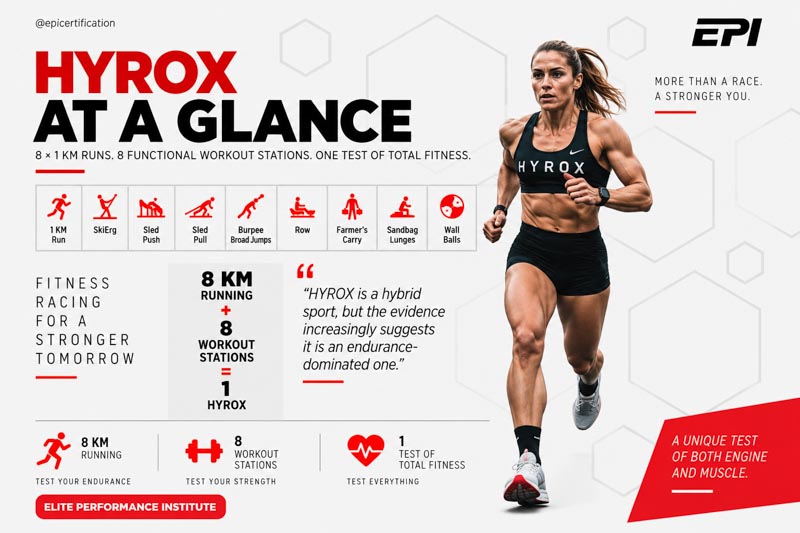
HYROX At A Glance
The individual race consists of eight 1 km runs, with one functional station following each run:
1 km Run → SkiErg → 1 km Run → Sled Push → 1 km Run → Sled Pull → 1 km Run → Burpee Broad Jumps → 1 km Run → Row → 1 km Run → Farmer’s Carry → 1 km Run → Sandbag Lunges → 1 km Run → Wall Balls.
That gives us 8 km of total running, performed while repeatedly transitioning into and out of muscular work. The important word here is repeatedly.
A HYROX athlete isn’t running a normal 8 km race. Every kilometre is influenced by what happened immediately beforehand.
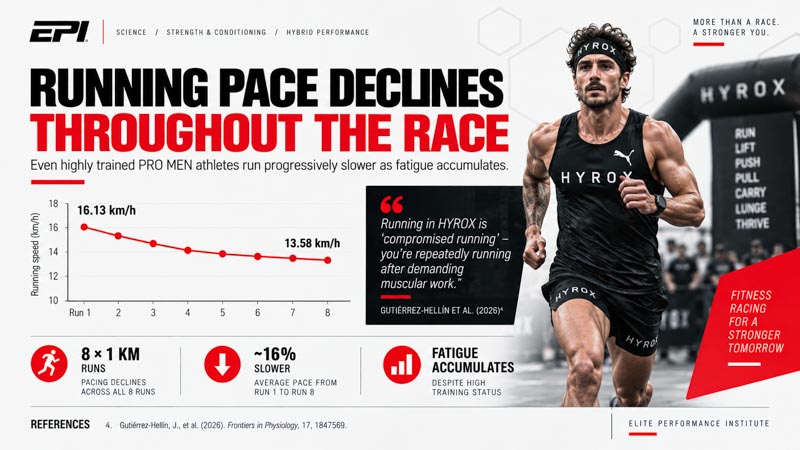
This is compromised running.
And understanding compromised running may be one of the keys to understanding HYROX performance.
How Much Of HYROX Is Actually Running?
The first HYROX-specific physiological study provides a useful starting point.
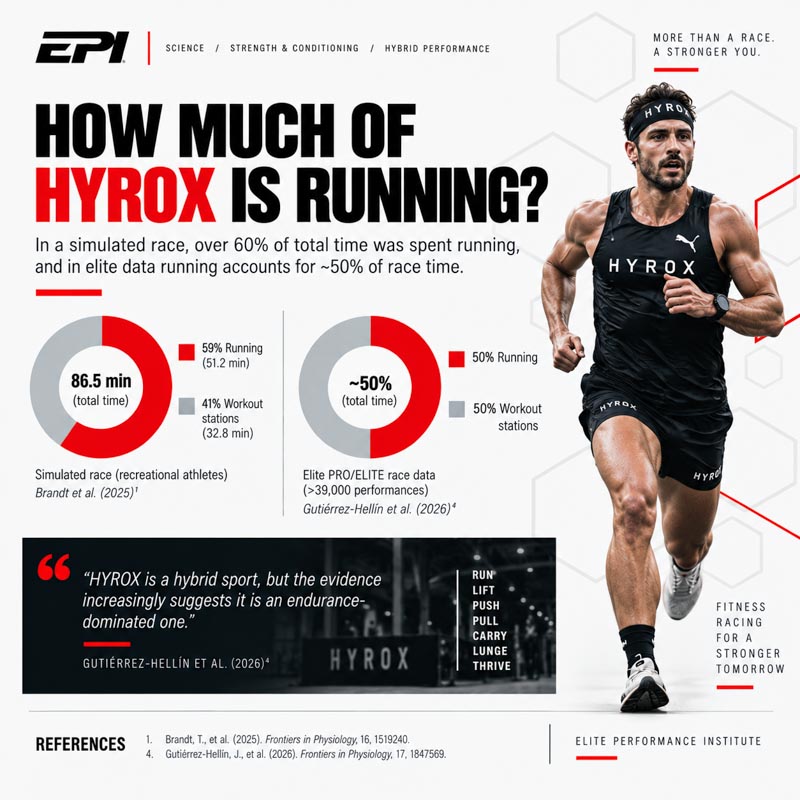
Brandt and colleagues investigated 11 recreational HYROX athletes completing a simulated Open competition. Median finishing time was 86.5 minutes, with approximately 51.2 minutes spent running compared with 32.8 minutes completing the exercise stations.
In other words, running represented roughly 59% of total completion time in this group.
More recent competition analyses point in the same direction. A large 2026 analysis of PRO and ELITE HYROX performances found that running consistently represented approximately 50% of total race time. Importantly, running performance was also closely aligned with overall finishing position.
So although HYROX contains some very visible strength-based tasks, approximately half, or potentially more, of the competition is still running.
From a programming perspective, that matters. If approximately half of your competition is running, running cannot simply be treated as conditioning added around the strength programme.
It needs to be trained as a primary performance quality.
What Predicts Faster HYROX Performance?
This is where the initial physiological research becomes particularly interesting.
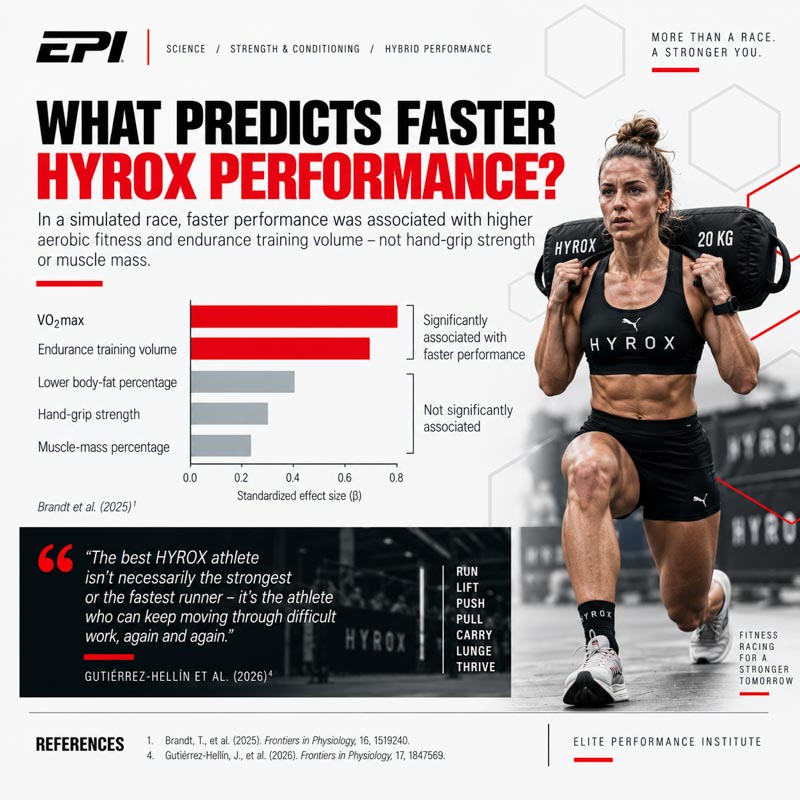
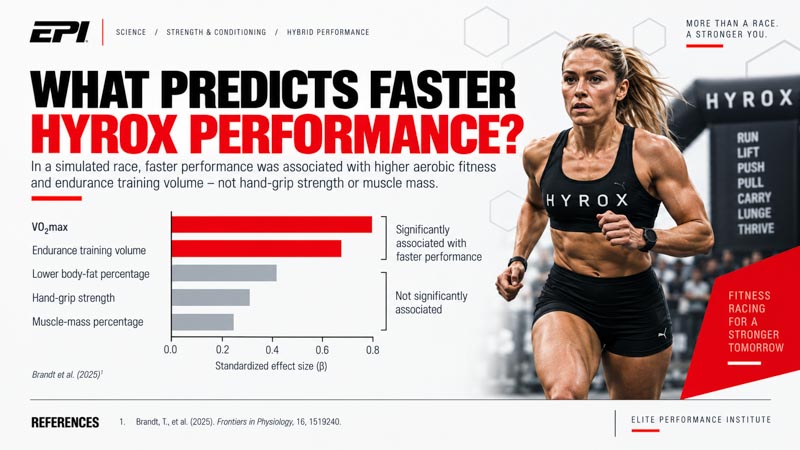
Brandt et al. assessed characteristics including VO2max, body composition, hand-grip strength and previous endurance and resistance-training volume.
Faster overall HYROX performance was significantly associated with:
higher VO2max, greater endurance-training volume and lower body-fat percentage.
By contrast, hand-grip strength and muscle-mass percentage were not significantly associated with overall performance in this small sample.
That doesn’t mean strength is irrelevant. It means the measures of strength used in this particular study did not predict overall race performance, whereas aerobic capacity did.
The distinction is important because this was a small study involving only 11 recreational athletes. We should therefore avoid turning the result into the simplistic claim that:
Strength doesn’t matter in HYROX.
The evidence doesn’t support that conclusion.
A more defensible interpretation is:
Once an athlete possesses sufficient strength to perform the stations effectively, aerobic capacity and running ability may become increasingly important determinants of overall race performance.
That creates an interesting concept for S&C coaches: strength reserve.
Strength Reserve: Being Strong Enough Rather Than Simply Strong
Imagine two athletes performing the same sled push.
For Athlete A, the competition load represents a very high percentage of their available force-producing capacity.
For Athlete B, the same load represents a considerably smaller percentage.
Even if they complete the station in similar times, the physiological cost may not necessarily be identical. This is why maximal strength still has value.
Increasing an athlete’s strength can reduce the relative intensity of a fixed competition load. But there is probably a point of diminishing returns.
Taking an athlete from insufficiently strong → sufficiently strong could have a substantial impact on HYROX performance.
Taking an already sufficiently strong athlete from very strong → exceptionally strong may provide less return if their primary limitation is aerobic capacity, running economy or fatigue resistance.
This gives coaches a much more useful question than “How strong can we make this athlete?”
Instead ask:
“How strong does this athlete need to be so that strength is no longer the major limiter?”
Strength Still Matters
The larger competition datasets provide an important counterbalance to the endurance argument.
The 2026 longitudinal analysis found that strength-determined stations produced greater changes in ranking and had larger effects among slower competitors. In other words, while running was strongly associated with overall performance, strength-oriented stations could still produce meaningful performance separation, particularly further down the performance distribution.
This makes intuitive sense.
An athlete with excellent aerobic fitness who reaches the sled and struggles to move it efficiently has a problem.
Likewise, insufficient strength or local muscular endurance during farmer’s carries, sandbag lunges or wall balls can produce substantial fatigue before the athlete begins running again.
Strength therefore has two jobs:
- It helps you complete the stations quickly.
- It helps you complete them cheaply enough that you can still run afterwards.
The second point may be even more important.

The Real HYROX Problem: Compromised Running
Running 1 km fresh is one thing.
Running 1 km immediately after a heavy sled push is another.
Running after 100 m of loaded lunges is another again.
And running your eighth kilometre after accumulating close to an hour of high-intensity work is completely different from running your first.
This is why normal running performance doesn’t tell the entire story.
A HYROX athlete needs the ability to preserve running speed despite repeated disruptions to locomotion, muscle recruitment and metabolic demand.
Recent elite data illustrate this clearly. A seven-season analysis of the Top 50 PRO MEN performances found that cumulative running time improved from approximately 36.2 minutes in 2018 to 30.1 minutes in 2024. Running pacing also became progressively more even, although late-race performance deterioration remained.
That final point matters.
Even highly trained HYROX athletes slow down as fatigue accumulates.
The performance question therefore isn’t simply:
How fast can you run?
It is:
How much of your running ability can you preserve after repeated functional work?
HYROX Performance Has Become Faster Largely Through Better Running
Perhaps the strongest evidence for the importance of running comes from looking at how elite HYROX performance has evolved.
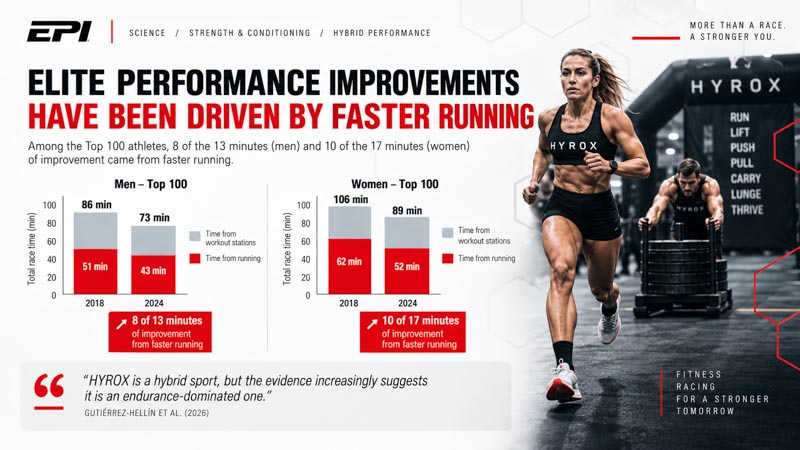
A 2026 study examining PRO and ELITE competition results across seven seasons reported that Top-100 race times improved by approximately 13 minutes in men and 17 minutes in women.
Of those improvements, approximately 8 minutes in men and 10 minutes in women were associated with faster running.
That is substantial.
It doesn’t mean workout stations haven’t improved. They have.
The separate Top-50 PRO MEN analysis found that from 2018 to 2024 total performance improved by 20.8%, while cumulative workout time improved by 19.2%.
Wall Balls and Sled Pull showed particularly large improvements.
The sport is getting faster everywhere.
But the broader data suggest that improvements in running have made a major contribution to the evolution of elite HYROX performance.
Pacing Matters More Than Many Athletes Realise
The Top-50 analysis also identified another important development: elite running splits have become progressively more even.
This has obvious coaching implications.
Going out aggressively during the opening kilometres might feel productive, but HYROX punishes unsustainable pacing.
Every early effort influences the station that follows. And every station influences the next run.
The athlete isn’t managing sixteen independent tasks. They are managing one continuous fatigue problem lasting roughly an hour or more.
Good pacing therefore requires athletes to control both running intensity and station intensity. The fastest possible sled push isn’t necessarily the best sled push if the physiological cost destroys the following kilometre. Likewise, saving ten seconds on an early run becomes irrelevant if it costs thirty seconds later.
The goal is not to maximise individual split performance.
The goal is to minimise total race time.
Pacing Matters More Than Many Athletes Realise
What does this mean for HYROX training?
The evidence argues against turning every training session into a HYROX simulation. Instead, athletes should develop the underlying qualities separately before progressively integrating them.
1. Build the aerobic engine
A meaningful proportion of weekly training should develop aerobic capacity and running performance. Depending on the athlete, this could include easy aerobic running, threshold work, interval training and race-specific running.
The exact distribution should reflect the athlete’s training history and weaknesses.
2. Develop sufficient maximal strength
Heavy resistance training still belongs in a HYROX programme.
Squats, deadlift variations, split squats, presses, rows and appropriate sled work can increase the athlete’s force-producing capacity.
The goal isn’t powerlifting performance. The goal is to create enough strength reserve that competition loads become manageable.
3. Develop muscular endurance
HYROX requires repeated contractions under fatigue. Wall balls, lunges, sleds, carries and burpees therefore require more than maximal strength.
Athletes need the ability to repeatedly express force without catastrophic reductions in performance. This is where appropriately programmed higher-repetition work, station-specific conditioning and density training can become useful.
4. Train compromised running
This should become increasingly important as competition approaches. Examples might include:
- 1 km run → sled push → 1 km run
- 1 km run → sandbag lunges → 1 km run
- Longer race-specific combinations
The objective isn’t simply to create fatigue. It is to teach the athlete to run efficiently while fatigued. That distinction is fundamental.
5. Practise pacing
Athletes should know what sustainable race intensity feels like before competition day.
Training should therefore occasionally rehearse target running pace, station intensity and transitions. Learning when not to accelerate can be just as important as learning when to push.
6. Periodise the programme
Not every session needs running followed by sleds followed by burpees followed by wall balls.
Constantly reproducing competition demands can create substantial fatigue while limiting the quality of individual adaptations.
There should still be periods where running quality is trained as running quality and strength is trained as strength.
As competition approaches, those qualities can increasingly be integrated.

So, Is HYROX More About Running Than Strength?
Current evidence suggests that running ability and aerobic fitness are central determinants of HYROX performance.
Running represents roughly half or more of competition time in the available studies, higher VO2max and endurance-training volume have been associated with faster performance, and improvements in running have contributed substantially to the progression of elite HYROX performances.
But saying HYROX is only about running misses the point. Strength-oriented stations still produce meaningful differences between competitors, and an athlete without sufficient strength will pay for that weakness both during the station and potentially during the run that follows.
The most useful S&C interpretation is therefore not running versus strength.
It is about the interaction between them.
Build enough strength that the stations are manageable.
Build enough aerobic capacity that you can recover while moving.
Develop enough muscular endurance that repeated stations don’t break you down.
Then teach the athlete to express all of those qualities while running under fatigue.
The best HYROX athlete isn’t necessarily the strongest athlete or the fastest fresh runner.
It is the athlete who can continue running fast after repeatedly doing things that should make running fast very difficult.

References
- Brandt, T., Ebel, C., Lebahn, C., & Schmidt, A. (2025). Acute physiological responses and performance determinants in HYROX© – a new running-focused high intensity functional fitness trend. Frontiers in Physiology, 16, 1519240.
- Rappelt, L., Wiedenmann, T., Held, S., Heinke, L., Micke, F., Wicker, P., & Donath, L. (2026). Longitudinal performance development in PRO and ELITE HYROX competitions across the first seven competitive seasons. Frontiers in Physiology, 17, 1847569.
- Gutiérrez-Hellín, J., Alonso-Domínguez, S., Martín-Gómez, F. J., Muñoz, A., Franco-Andrés, A., Yustres-Amores, I., del Cerro, J. S., & Del Coso, J. (2026). Performance trends and pacing evolution in elite HYROX©: A seven-season analysis of Top 50 PRO Men (2018–2024). Applied Sciences, 16(13), 6674.