
Return to sport (RTS): what physiotherapists and sports therapists need from strength and conditioning
The gap between symptom-free and sport-ready is where most reinjury happens. How to define it, measure it and close it, physically and psychologically.
In sports injury management, the handover is often the part nobody owns. The physiotherapist takes the athlete to symptom-free, restores range of motion and basic strength, clears whatever functional tests are available, and discharges. Full training resumes weeks or months later, and in many settings no one is explicitly responsible for what happens in between.
That interval is where reinjury happens, and it is structurally where S&C should sit. This updated guide adds recent research on how return to sport is defined, what holds athletes back psychologically, how readiness is measured, and what a structured return to play programme looks like in practice.
“Cleared to play” is not a clinical statement
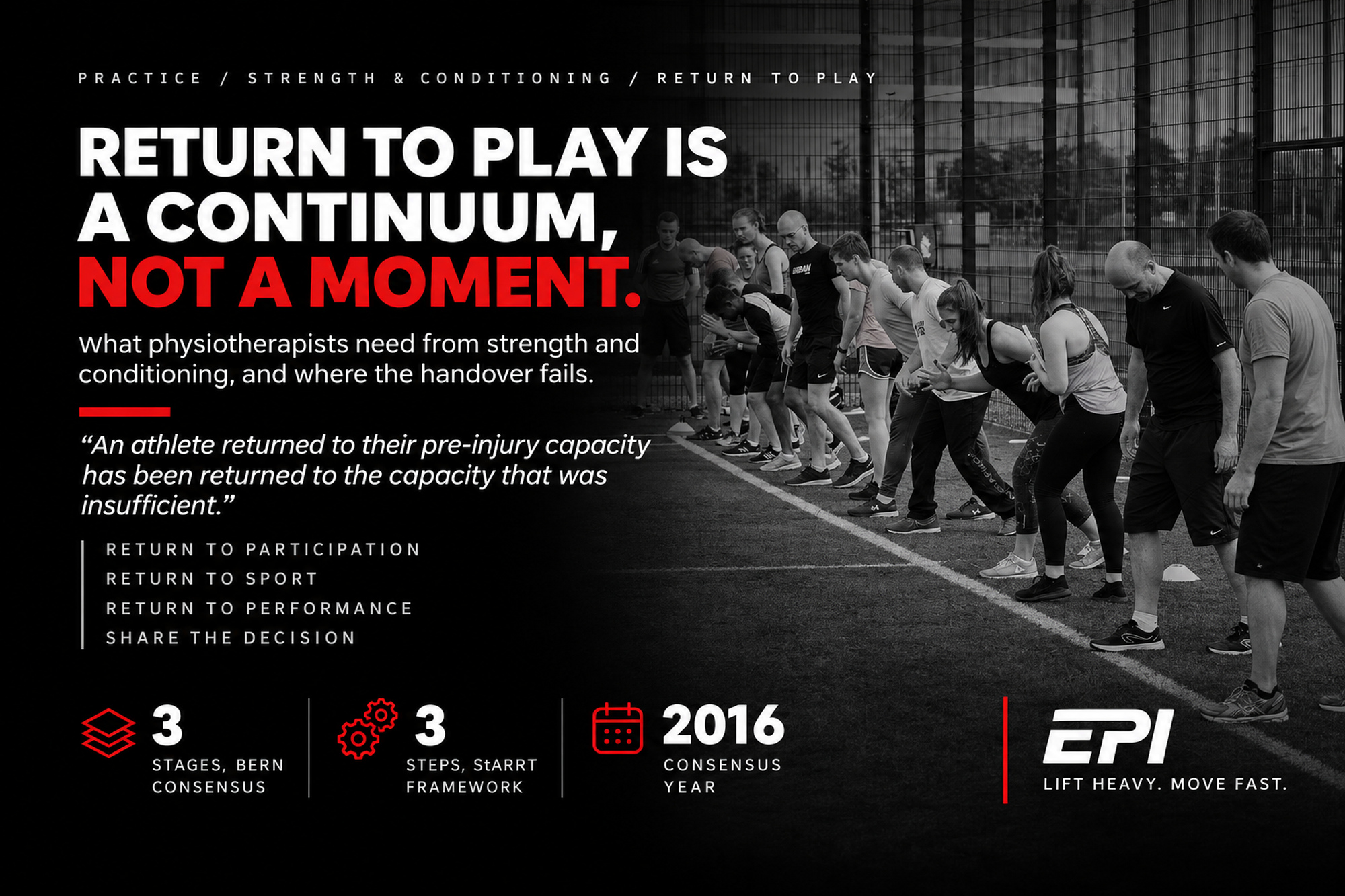
The Bern consensus split one binary decision into three stages:
- Return to participation: physically active, but not yet medically, physically or psychologically ready for sport. The athlete may be training or rehabbing below their return to sport goal.
- Return to sport: back in the defined sport but not at the desired level. The consensus notes that, for some athletes, this is a successful outcome in itself.
- Return to performance: gradually back in the sport and performing at or above pre-injury level.
Once these stages exist, “cleared” becomes a question: cleared to what? Most discharge conversations are really return to participation decisions communicated as if they were return to performance, and the athlete hears the second.
The research has the same problem
A 2021 systematic review screened 718 orthopaedic papers and found 29 that clearly defined return to sport. Their definitions ranged from “played one game” to “back at pre-injury level” to “returned to training”.
The definition changes the answer dramatically. After hip arthroscopy for femoroacetabular impingement (FAI), the headline return to sport rate falls from around 90% to around 20% depending on what counts as “returned”:
The StARRT framework, and why S&C changes one of its three variables
The Bern consensus presents the Strategic Assessment of Risk and Risk Tolerance (StARRT) model, which works in three steps:
| Step | What it assesses | Mainly shaped by |
|---|---|---|
| 1. Tissue health | How much load the injured tissue can absorb before it fails | Rehab first, then S&C |
| 2. Tissue stresses | The cumulative load the sport will place on that tissue | The sport and its schedule |
| 3. Risk tolerance modifiers | Context that shapes how much risk decision-makers will accept: timing, pressure, stakes | Athlete, coach, club, clinician |
Rehab works mainly on the first variable, and the sport determines the second. S&C exists to raise tissue health above the demands of the sport, not just restore it to its pre-injury level.
Returning an athlete to pre-injury capacity means returning them to a capacity that was already insufficient once. That isn’t a criticism of rehab. It is the reason a handover is needed rather than a discharge.
What the gap actually looks like
An athlete discharged from rehab is commonly:
- Symptom-free at rest and in controlled movement.
- Within an acceptable margin on whatever symmetry or hop testing was available.
- Not yet exposed to chaotic, sport-specific load: unplanned deceleration, contact, fatigue and competition.
- Below their pre-injury strength and power baseline, often substantially.
- Psychologically untested in the situation that caused the injury.
The last three are S&C problems, and none of them usually appears in a discharge note.
Time and criteria both matter
ACL reconstruction shows the stakes most clearly. Across the literature, about 82% of athletes return to some sport after ACL reconstruction, but only about 65% return to their pre-injury level, and the gap between surgery and return typically runs 6–13 months. Returning too early is costly: young athletes who returned before 9 months had a rate of new injury seven times that of those who waited (Beischer et al., 2020), while simple return to sport decision rules reduced reinjury risk by 84% in the Delaware-Oslo cohort (Grindem et al., 2016).
A second reconstruction makes the gap wider. A 2026 meta-analysis of 19 studies and 3,209 athletes compared revision with primary ACL reconstruction:
Revision athletes returned slightly less often (73% vs 79%), less often at their pre-injury level (43% vs 48%) and about 1.2 months later. The biggest difference was psychological: their average ACL-RSI score of 60.1 sat below the cutoff of 65 associated with a successful return. The authors recommend combining exercise with psychological interventions after revision surgery.
The gap nobody tests for
Physical clearance and psychological readiness don’t always arrive together. Kvist et al. found that re-injury anxiety held back athletes who were otherwise healthy and medically cleared to return. A review by Podlog et al. (2011) identified five common concerns in returning athletes:
| Concern | What it looks like |
|---|---|
| Re-injury anxiety | Hesitation in drills the athlete is physically capable of, heightened emotion at the end of rehab, stalling progress |
| Performing to pre-injury standard | Worry about lost skill, lost fitness and teammates who improved while they were out. Usually eases within six months of returning |
| Isolation and identity | Feeling cut off from the team and coaches, and from a body that can no longer perform |
| Pressure to return | From coaches, teammates, family, or the athlete themselves. Coaches report that much of this pressure is self-imposed |
| Self-presentation | Fear of looking unfit, unskilled or “not as good as before” in front of others |
These concerns are not just about comfort. Under the stress-injury model, anxiety can cause muscular tension, poorer timing and narrowed attention, all of which raise injury risk. In one NFL study, running backs and wide receivers produced 33% fewer rushing and receiving yards and touchdowns after returning from serious knee injury.
What athletes say holds them back
Qualitative studies, which let athletes explain in their own words, find the same themes across very different injuries (DeMaio et al., 2023):
| Injury | Key barriers and motivators reported by athletes |
|---|---|
| SLAP tear (shoulder) | Lifestyle change, fear of reinjury, feeling of instability, residual pain, lack of confidence |
| Shoulder instability | Competing interests, ageing, fear of movement (kinesiophobia), internal motivation |
| UCL reconstruction (elbow) | Trust in the care team, drive and optimism, and misconceptions that the new ligament would make them better than before |
| FAI (hip) | Expectations not matching progress, variable activity tolerance, low psychological readiness, frustration with support and information |
| ACL reconstruction | Fear, lack of confidence, threat to identity, comparisons with peers, life reprioritisation, and the role of the support system |
In one ACL study, only 5 of 18 participants were back at their pre-injury level of sport a year after injury. High school athletes reported psychosocial barriers as harder to overcome than physical ones.
Measuring readiness
Validated questionnaires make psychological readiness something you can track, not guess:
| Scale | Used after | What the numbers mean |
|---|---|---|
| ACL-RSI | ACL injury and reconstruction | 12 items scored 0–100 covering emotions, confidence and risk appraisal. A score of 65 or more at 6 months predicted 3–4 times greater odds of returning to sport at 12 months. Track it across visits, not once |
| SIRSI | Shoulder instability, with or without surgery | Each 10-point rise linked to 2.9 times greater likelihood of returning. Median score of those who returned: 65 |
| Short SIRSI | Shoulder instability | 5 items covering confidence, reinjury risk, emotion and rehab or surgery, for busy clinics |
| SLAP-RSI | SLAP tear surgery | Validated for tracking readiness alongside physical measures through rehab |
Meeting the athlete’s psychological needs
Podlog et al. frame these concerns using self-determination theory: athletes need to feel competent, connected and in control. Each need suggests practical strategies that physios and S&C coaches can use:
| Need | Concern | What practitioners can do |
|---|---|---|
| Competence | Re-injury anxiety, doubts about performance | Use progressive functional and fitness testing so the athlete has evidence they are ready. Set SMARTS goals (specific, measurable, action-oriented, realistic, time-based, self-determined). Use modelling, relaxation and imagery |
| Relatedness | Isolation, loss of identity | Keep the athlete in team sessions with exercises they can do. Offer listening, emotional and informational support. Remind them sport is something they do, not who they are |
| Autonomy | Pressure to return | Involve the athlete in their goals. Step in when pressure is pushing a premature return, and discuss the consequences with athlete, coach and family |
What physiotherapists should be able to ask of an S&C coach
When handing over an athlete, a physiotherapist can reasonably expect:
A plan expressed in load, not exercises. Exposure, volume, weeks and the pattern of step-ups.
Objective reassessment at agreed points, using measures agreed before the handover, so any later disagreement is about data, not opinion. That includes psychological readiness, not just strength and hop scores.
Knowing where the S&C remit ends. A coach who starts treating is a problem. A coach who notices a change and calls the physio is doing the job.
Communicating with the sport coach in the sport coach’s language. Pressure to return early often comes from someone who doesn’t read clinical notes, and the S&C coach is usually better placed to absorb it.
What S&C coaches should be asking of you
The expectations run both ways. Before taking over, the S&C coach should know:
- What was injured, and the tissue’s healing timeline.
- Which movements or loads are contraindicated, and until when.
- The athlete’s reinjury risk profile.
- What has already been tested, and the numbers, including any readiness score such as the ACL-RSI and its trend.
- Who holds the final return to sport decision.
What a structured return looks like in practice
A 2025 systematic review of return to play programmes in tennis players (mostly shoulder injuries, mean age about 20) organised the evidence into the same three Bern stages. It is a useful template for how load, intensity and sport-specific skill build together:
| Phase | Weeks | Focus | Load guide |
|---|---|---|---|
| Return to participation | 1–2 | Mobility and simple groundstrokes, starting around 10 reps and building to 30. Light strength work | RPE below 6/10, volume no more than 15% of a match |
| Return to sport | 3–6 | Technical volume rises; volleys from week 3, overheads from week 5. Serve starts below 25% of pre-injury speed | RPE 8–10/10, about 70% of match volume |
| Return to performance | 6+ | Serves near full intensity by week 8, conditioned simulated matches | 100% of pre-injury training volume |
Two cautions. The review found only five eligible studies from 1,164 screened, so these are guidelines, not proven protocols. And the authors stress that the duration and progression of each phase should be tailored to the individual player.
Shared decision making, and the one exception
The Bern consensus says the return to sport decision should be shared among all stakeholders. That needs defined roles and a process for resolving disagreements, to protect the athlete from coercion when people have different risk tolerances.
A coach who needs the player on Saturday, a physio who carries the clinical liability and an athlete who wants to play have genuinely different appetites for risk. Without agreed roles, the athlete is caught in the middle. And the pressure isn’t always external: athletes often push themselves back early because they are losing confidence, feeling isolated or worrying about lost fitness.
The exception is when the athlete’s health is at risk. Removal from sport after a concussion is not a shared decision.
Where the evidence is honestly thin
The consensus takes no firm position on criteria-based versus time-based return. It emphasises graded, criterion-based progression aligned to the athlete’s return to sport goal, but for some injuries, such as Achilles tendon rupture, only time-based criteria exist. It also acknowledges that return to sport criteria for many injuries lack solid evidence and consensus.
The newer research reinforces that. There is no gold-standard return to sport test after ACL reconstruction. One review recommends combining five areas (psychological factors, functional tests, strength tests, time, and modifiable and non-modifiable risk factors) without saying how to weight them. Others suggest adding cognitive tasks to functional tests, because sport asks athletes to read a play while they cut and pivot. And the certainty of evidence comparing revision and primary ACL outcomes was rated very low.
The framework is sound. The specific thresholds often aren’t. Anyone selling a definitive return to play test battery for every injury is ahead of the literature.
Why this matters beyond any individual athlete
Physiotherapy and S&C are not competing for the same role. The physio restores tissue health and manages the clinical picture. The S&C coach builds capacity beyond the demands of the sport. Athletes need both, one after the other and sometimes at the same time, and outcomes depend on whether the two work from a shared model.
The Bern continuum is the most useful shared model available. It gives both professions the same language for where an athlete is, which is most of what a good handover needs.
EPI delivers the National Certificate in Strength and Conditioning in Dublin and Belfast.
Frequently asked questions
What is the difference between return to play and return to performance?
The Bern consensus describes three stages: return to participation (active but not ready for sport), return to sport (back in the sport but below the desired level) and return to performance (at or above pre-injury level).
When should strength and conditioning become involved in rehabilitation?
Before discharge, not after. An overlap works better than a transfer, because the S&C plan should build on the clinician’s testing data rather than start from scratch.
What is the StARRT framework?
The Bern consensus model for return to sport decisions, with three steps: tissue health, expected tissue stresses and risk tolerance modifiers.
How do you measure psychological readiness to return to sport?
With validated scales such as the ACL-RSI after knee injury or the SIRSI after shoulder instability. An ACL-RSI score of 65 or more at six months is linked to 3–4 times greater odds of returning to sport. Track the score over time rather than testing once.
How long does return to sport take after ACL reconstruction?
Typically 6–13 months, and the evidence supports waiting at least 9 months. Young athletes who returned before 9 months had a rate of new injury seven times higher than those who waited. Revision surgery adds about 1.2 months on average.
Who should make the final return to sport decision?
It should be shared across stakeholders, with defined roles and a way of resolving disagreements so the athlete isn’t coerced. The exception is when health is at risk, such as removal from play after a concussion.
Are return to play test batteries evidence-based?
The framework is better supported than the thresholds. Many return to sport criteria lack solid evidence and consensus, and some injuries have only time-based criteria.
EPI’s National Certificate in Strength and Conditioning covers load progression, testing and the return to performance phase, delivered in Dublin and Belfast.
Check the Dublin dates, or ask EPI whether your existing qualification counts towards Phase 2 entry.
References
- Ardern, C. L., Glasgow, P., Schneiders, A., et al. (2016). 2016 consensus statement on return to sport from the First World Congress in Sports Physical Therapy, Bern. British Journal of Sports Medicine, 50(14), 853–864.
- Beischer, S., Gustavsson, L., Senorski, E. H., et al. (2020). Young athletes who return to sport before 9 months after anterior cruciate ligament reconstruction have a rate of new injury 7 times that of those who delay return. Journal of Orthopaedic & Sports Physical Therapy, 50, 83–90.
- DeMaio, E. L., Tompson, J. D., Terry, M. A., & Tjong, V. K. (2023). Qualitative research in return to sport: A current review of the literature. Current Reviews in Musculoskeletal Medicine, 16, 480–487.
- Doege, J., Ayres, J. M., Mackay, M. J., Tarakemeh, A., Brown, S. M., Vopat, B. G., & Mulcahey, M. K. (2021). Defining return to sport: A systematic review. Orthopaedic Journal of Sports Medicine, 9(7), 23259671211009589.
- Grindem, H., Snyder-Mackler, L., Moksnes, H., Engebretsen, L., & Risberg, M. A. (2016). Simple decision rules can reduce reinjury risk by 84% after ACL reconstruction: The Delaware-Oslo ACL cohort study. British Journal of Sports Medicine, 50, 804–808.
- Manojlovic, M., Milankov, V., Roklicer, R., Trivic, T., Veraksa, A., Bianco, A., & Drid, P. (2026). Return-to-sport outcomes and psychological readiness to return to sport after revision compared to the primary anterior cruciate ligament reconstruction: A systematic review. Sports Medicine – Open, 12, 47.
- Martín-Castellanos, A., Barba-Ruiz, M., Herrera-Peco, I., Amor-Salamanca, M. S., Rodríguez-González, E. M., & Hermosilla-Perona, F. (2025). A systematic review of the best-practice return to play programs in tennis players. PLoS ONE, 20(3), e0317877.
- Podlog, L., Dimmock, J., & Miller, J. (2011). A review of return to sport concerns following injury rehabilitation: Practitioner strategies for enhancing recovery outcomes. Physical Therapy in Sport, 12, 36–42.
- Webster, K. E., Feller, J. A., & Lambros, C. (2008). Development and preliminary validation of a scale to measure the psychological impact of returning to sport following anterior cruciate ligament reconstruction surgery. Physical Therapy in Sport, 9(1), 9–15.