
Quick answer: Coaches in Northern Ireland can study strength and conditioning through UK framework-levelled awards, university programmes, or practical CPD courses run locally. EPI delivers the full pathway in Belfast – Phase 1, Phase 2, the complete NCSC and the Youth S&C Course – on Friday-to-Sunday weekends, with fees from €595.
Northern Ireland sits between two qualification systems, which makes choosing a strength and conditioning (S&C) course more confusing here than almost anywhere else. Courses advertised locally may be levelled under the UK system, while providers based in the Republic work to a different framework and price in euro. This guide sorts out what is available, what the differences actually mean, and how to judge value.
What S&C study options exist in Northern Ireland
Broadly, there are three routes:
- UK framework-levelled courses. Usually advertised by their RQF level, often delivered as blended programmes with online study and practical days.
- University study. Degree and postgraduate programmes in strength and conditioning or sports science, aimed at longer-term careers in performance sport.
- Practical CPD courses. Short, intensive courses focused on coaching skills, often run over weekends and usually carrying continuing-education approval from bodies such as the NSCA or ACE.
None is automatically better. They answer different questions, which is the point most course marketing skips over.
How qualifications work differently in Northern Ireland
Northern Ireland shares the Regulated Qualifications Framework (RQF) with England, and CCEA Regulation is responsible for regulating qualifications offered here. So a course advertised as “Level 4” in Belfast is referring to the RQF, and you can check any regulated qualification on the official Register of Regulated Qualifications.
Qualifications from the Republic sit on a different framework, the NFQ, and the level numbers do not map across one-to-one. CPD courses sit outside both frameworks and are measured a third way – by continuing-education approval. Our guide to how S&C qualifications are recognised in Ireland and Northern Ireland explains each system and which employers care about which.
The practical takeaway for a coach in Belfast: decide what your next employer, club or insurer actually asks for before you compare course prices.
Judging value for money on a Belfast course
Contact hours, not just days
A “three-day course” can mean very different things. Ask for the timetable and count the teaching hours, then ask what share is practical coaching rather than lecture. EPI publishes its course timetable: days run 08:30 to around 16:30, which works out at roughly 19 to 20 hours of teaching per three-day phase, with more than half the sessions practical.
What is included beyond the days themselves
Check whether the exam, materials and any ongoing access are part of the price. With EPI’s in-person courses, registration includes free access to the on-demand version of the course and the online Velocity Based Training course, plus ebooks and resources on its learning platform.
How often the provider actually runs in Belfast
Some national providers advertise Belfast but run there once or twice a year, which matters if you need to complete a two-part qualification or want to retake something. Ask how many dates run locally in a typical year, and whether the same tutors deliver them. A provider with a settled local schedule is easier to plan around.
A note on currency
EPI prices its courses in euro, including Belfast dates. If you are paying from a sterling account, your card provider converts at its own rate and may add a fee, so build a small margin into your budget. The published fee is €595 per phase and €1,200 for the full NCSC.
Travel and time off
A local course in Belfast saves you the cost of travelling to Dublin or Great Britain, which on a three-day weekend can be a meaningful share of the total. Weekend delivery also means you are not giving up billable weekdays.
Studying in Belfast or travelling for a course?
Plenty of coaches in Northern Ireland consider travelling to Dublin, Glasgow or Manchester for a course. It can be the right call if a specific provider or specialism is only available there, but be honest about the full cost. Two or three nights’ accommodation, travel and food on a three-day weekend can add several hundred pounds, and it has to be repeated for the second half of a two-part qualification.
The other consideration is the people. A course run locally tends to put you in a room with coaches working in the same clubs, schools and leagues you do. That network is often worth as much afterwards as the certificate, and it is the part you lose when you travel to a city where you know nobody.
Coaching athletes in Belfast: what an S&C course prepares you for
If you are coaching athletes rather than general-population clients, the skills you need are specific: testing and profiling, developing acceleration and top-end speed, coaching the Olympic lifts safely, programming strength and power, developing the right energy systems, and planning all of it across a season that already has fixtures in it.
That is the content of a practical S&C course. The other half of the job is knowing your limits – when to refer to a physiotherapist, and how to work alongside a team’s coaching staff rather than against their plan.
If you work with underage squads, that is a distinct skill set again. Training young athletes is not adult training scaled down, which is why it usually needs its own qualification.
EPI in Belfast: courses, dates and fees
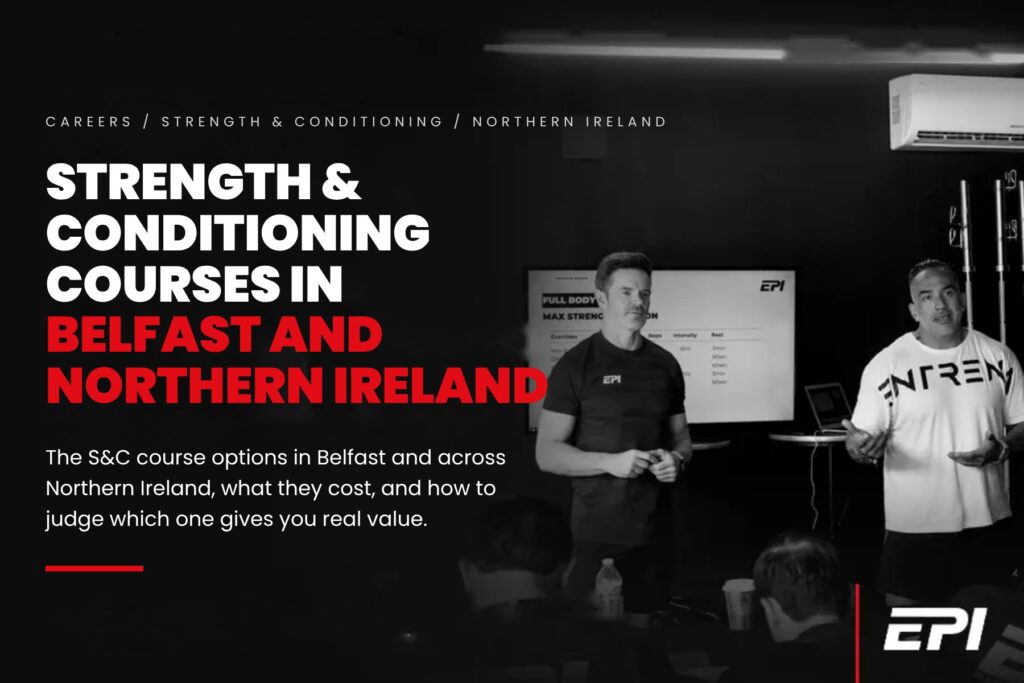
EPI has delivered courses in Northern Ireland since 2014 and runs the full pathway in Belfast. Upcoming Belfast dates:
| Course | Dates | Fee |
|---|---|---|
| Full NCSC, Belfast | 4 December 2026 – 28 February 2027 | €1,200 |
| Phase 1, Belfast | 4–6 December 2026 | From €595 |
| Youth S&C Course, Belfast | 4–6 December 2026 | From €595 plus €100 exam |
| Phase 2, Belfast | 26–28 February 2027 | From €595 |
The December intake and the February Phase 2 date fit together: complete both and you are awarded the full National Certificate in Strength & Conditioning. All current dates are on the upcoming course dates page.
Funding: what applies in Northern Ireland
The Training Support Grant, which covers up to €1,000 of course fees, is a Department of Social Protection scheme in the Republic of Ireland and applies to people receiving Irish social welfare payments. If you live in Northern Ireland, that scheme will not apply to you, so check what employer support or local funding is available instead. Our guide to S&C course prices and funding covers the Irish scheme in detail.
Frequently asked questions
Are EPI’s Belfast courses the same as the Dublin courses?
Yes. The same syllabus, the same assessment and the same certificate apply in both cities. Belfast runs the full pathway – Phase 1, Phase 2, the complete NCSC and the Youth S&C Course – Friday to Sunday, exactly as Dublin does. EPI has been delivering courses in Northern Ireland since 2014.
Can I pay in pounds sterling for a Belfast course?
EPI lists its course fees in euro, including for Belfast. If you pay by card from a sterling account, your bank or card provider will convert at its own rate and may add a fee, so the final sterling amount will vary slightly. Check with EPI if you need a sterling invoice.
What qualification do I need to coach athletes in Northern Ireland?
There is no single universal requirement. Clubs, schools, gyms and insurers set their own, and some job adverts specify an RQF level while others ask for practical experience or a professional accreditation. Check what the specific role requires, and make sure your insurance covers the work you intend to do.
| Studying in Belfast?
See upcoming Belfast course dates or contact the EPI team with any questions about fees, payment or course entry requirements. |